
Join Our JEE Preparation Group
Prep with like-minded aspirants; Get access to free daily tests and study material.
Sign in
Please select an account to continue using cracku.in
↓ →
Join Our JEE Preparation Group
Prep with like-minded aspirants; Get access to free daily tests and study material.
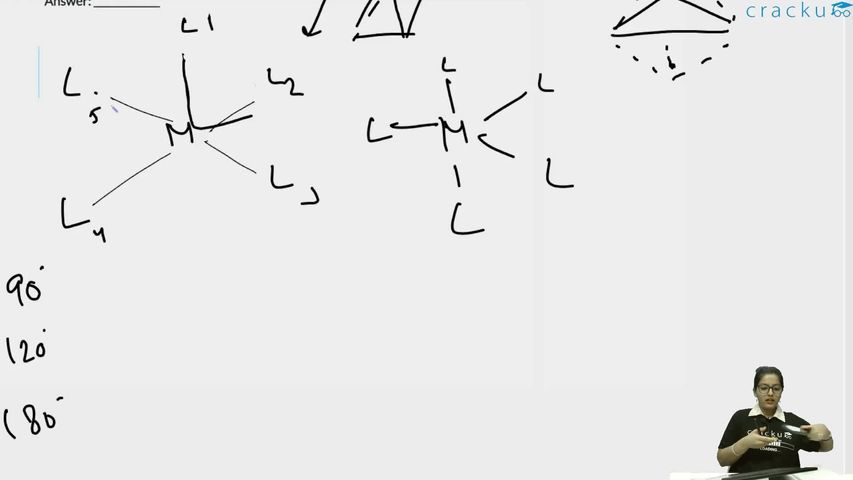
Complexes (ML$$_5$$) of metals Ni and Fe have ideal square pyramidal and trigonal bipyramidal geometries, respectively. The sum of the 90$$^\circ$$, 120$$^\circ$$ and 180$$^\circ$$ L-M-L angles in the two complexes is
Correct Answer: 20
First we note that an ML5 complex contains a total of five ligands around the central metal atom, so the total number of possible L-M-L angles is obtained from the combination formula $${}^{\,5}C_{2} \;=\; \dfrac{5\times4}{2\times1}=10.$$ Hence, in each ML5 geometry there are ten distinct L-M-L angles. We now have to identify, for the two given geometries, which of those ten angles are exactly $$90^{\circ},\;120^{\circ}\text{ or }180^{\circ}.$$
Square-pyramidal geometry (Ni complex)
In an ideal square pyramid four ligands occupy the corners of a square base (let us label them B1, B2, B3, B4) and one ligand (A) is located axially above the centre of that square.
We classify every pair of ligands and write down the corresponding angle:
1. Axial-basal pairs: A-B1, A-B2, A-B3, A-B4
Each of these four angles is $$90^{\circ}.$$
2. Adjacent basal pairs: B1-B2, B2-B3, B3-B4, B4-B1
Since the base is a square, the angle between any two adjacent basal ligands is also $$90^{\circ}.$$
Thus we get another four $$90^{\circ}$$ angles.
3. Opposite basal pairs: B1-B3, B2-B4
Being diametrically opposite on the square, these two pairs form the straight line angle $$180^{\circ}.$$
Adding up the square-pyramidal angles that are exactly $$90^{\circ},$$ $$120^{\circ},$$ or $$180^{\circ}:$$
$$90^{\circ}\text{ angles}=4+4=8$$
$$120^{\circ}\text{ angles}=0$$
$$180^{\circ}\text{ angles}=2$$
Trigonal-bipyramidal geometry (Fe complex)
In an ideal trigonal bipyramid three ligands (E1, E2, E3) occupy the equatorial positions forming a perfect triangle, while two ligands (A1, A2) reside axially.
Again we list every type of pair:
1. Axial-equatorial pairs: Each axial ligand makes $$90^{\circ}$$ with every equatorial ligand. Number of such pairs: $$2\times 3 = 6,$$ each at $$90^{\circ}.$$
2. Equatorial-equatorial pairs: The three equatorial ligands lie in a plane with $$120^{\circ}$$ between each adjacent pair. Number of such pairs: $$^3C_{2}=3,$$ each at $$120^{\circ}.$$
3. Axial-axial pair: The two axial ligands are collinear, giving one angle of $$180^{\circ}.$$
Hence, for the trigonal bipyramid we have
$$90^{\circ}\text{ angles}=6$$
$$120^{\circ}\text{ angles}=3$$
$$180^{\circ}\text{ angles}=1$$
Total for both complexes taken together
$$$\begin{aligned} 90^{\circ}\text{ angles}&=8+6=14,\\ 120^{\circ}\text{ angles}&=0+3=3,\\ 180^{\circ}\text{ angles}&=2+1=3. \end{aligned}$$$
The required sum of the numbers of $$90^{\circ},\;120^{\circ}$$\text{ and }$$180^{\circ}$$ angles is therefore
$$14+3+3 = 20.$$
Hence, the correct answer is Option D.
Was this solution helpful?
Click on the Email ☝️ to Watch the Video Solution
Create a FREE account and get:
_1.webp)

Educational materials for JEE preparation

Ask our AI anything

AI can make mistakes. Please verify important information.
AI can make mistakes. Please verify important information.


