
Join Our JEE Preparation Group
Prep with like-minded aspirants; Get access to free daily tests and study material.
Sign in
Please select an account to continue using cracku.in
↓ →
Join Our JEE Preparation Group
Prep with like-minded aspirants; Get access to free daily tests and study material.
Let $$\bar{z}$$ denote the complex conjugate of a complex number $$z$$ and let $$i = \sqrt{-1}$$. In the set of complex numbers, the number of distinct roots of the equation
$$\bar{z} - z^2 = i(\bar{z} + z^2)$$
is ______.
Correct Answer: 4
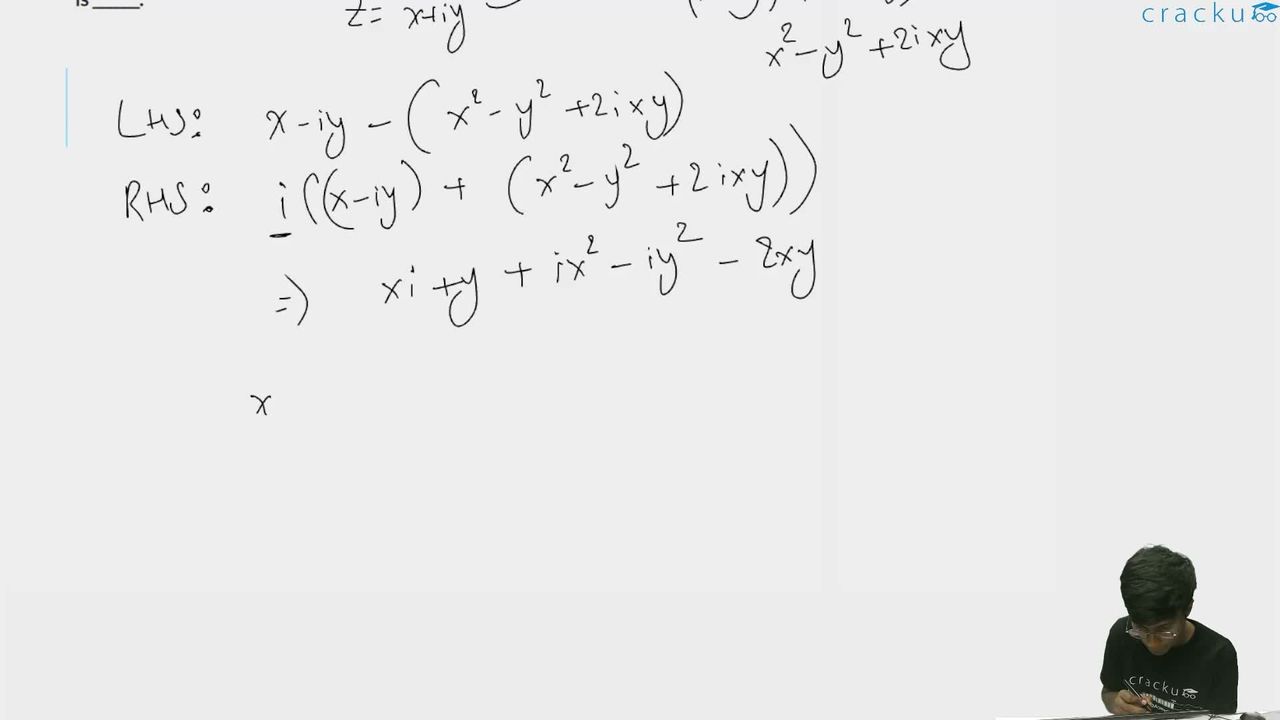
Let $$z = x + iy$$, where $$x, y \in \mathbb{R}$$. Then $$\bar{z} = x - iy$$ and $$z^2 = (x + iy)^2 = x^2 - y^2 + 2ixy$$.
Substitute these in the given equation
$$\bar{z} - z^2 = i\bigl(\bar{z} + z^2\bigr)$$
Left side (LHS):
$$(x - iy) - (x^2 - y^2 + 2ixy) = (x - x^2 + y^2) + i(-y - 2xy)$$
Right side (RHS):
$$i\!\Bigl[(x - iy) + (x^2 - y^2 + 2ixy)\Bigr]$$
$$= i\bigl(x + x^2 - y^2\bigr) + i(i)\bigl(-y + 2xy\bigr)$$
$$= i\bigl(x + x^2 - y^2\bigr) - \bigl(-y + 2xy\bigr)$$
$$= (\,y - 2xy\,) + i\bigl(x + x^2 - y^2\bigr)$$
Equate real and imaginary parts:
Real part:
$$x - x^2 + y^2 = y - 2xy \quad -(1)$$
Imaginary part:
$$-y - 2xy = x + x^2 - y^2 \quad -(2)$$
Rewrite both relations in a common format:
$$(1)\;:\; -x^2 + x + 2xy + y^2 - y = 0$$ $$(2)\;:\; -x^2 - 2xy - x + y^2 - y = 0$$
Subtract $$(2)$$ from $$(1)$$ to eliminate the quadratic terms:
$$(1) - (2):\; 2x + 4xy = 0 \;\Longrightarrow\; 2x(1 + 2y) = 0$$ $$\therefore \; x = 0 \quad \text{or} \quad 1 + 2y = 0$$
Case 1: $$x = 0$$
Put $$x = 0$$ in $$(1)$$:
$$0^2 - 0 + y^2 - y = 0 \;\Longrightarrow\; y(y - 1) = 0$$
Hence $$y = 0 \quad\text{or}\quad y = 1$$.
Solutions:
$$z = 0 \quad\text{and}\quad z = i$$
Case 2: $$1 + 2y = 0 \;\Longrightarrow\; y = -\frac12$$
Put $$y = -\frac12$$ in $$(1)$$:
$$-x^2 + x + 2x\!\left(-\frac12\right) + \left(-\frac12\right)^2 - \left(-\frac12\right) = 0$$ $$-x^2 + x - x + \frac14 + \frac12 = 0$$ $$-x^2 + \frac34 = 0 \;\Longrightarrow\; x^2 = \frac34$$ $$\therefore\; x = \pm\frac{\sqrt3}{2}$$
Solutions:
$$z = \frac{\sqrt3}{2} - \frac{i}{2}, \quad z = -\frac{\sqrt3}{2} - \frac{i}{2}$$
Combining both cases, the four distinct roots are
$$z = 0,\quad z = i,\quad z = \frac{\sqrt3}{2} - \frac{i}{2},\quad z = -\frac{\sqrt3}{2} - \frac{i}{2}.$$
Hence, the equation possesses 4 distinct roots.
Final Answer: 4
Was this solution helpful?
Click on the Email ☝️ to Watch the Video Solution
Create a FREE account and get:
_1.webp)

Educational materials for JEE preparation

Ask our AI anything

AI can make mistakes. Please verify important information.
AI can make mistakes. Please verify important information.
