
Join Our JEE Preparation Group
Prep with like-minded aspirants; Get access to free daily tests and study material.
Sign in
Please select an account to continue using cracku.in
↓ →
Join Our JEE Preparation Group
Prep with like-minded aspirants; Get access to free daily tests and study material.
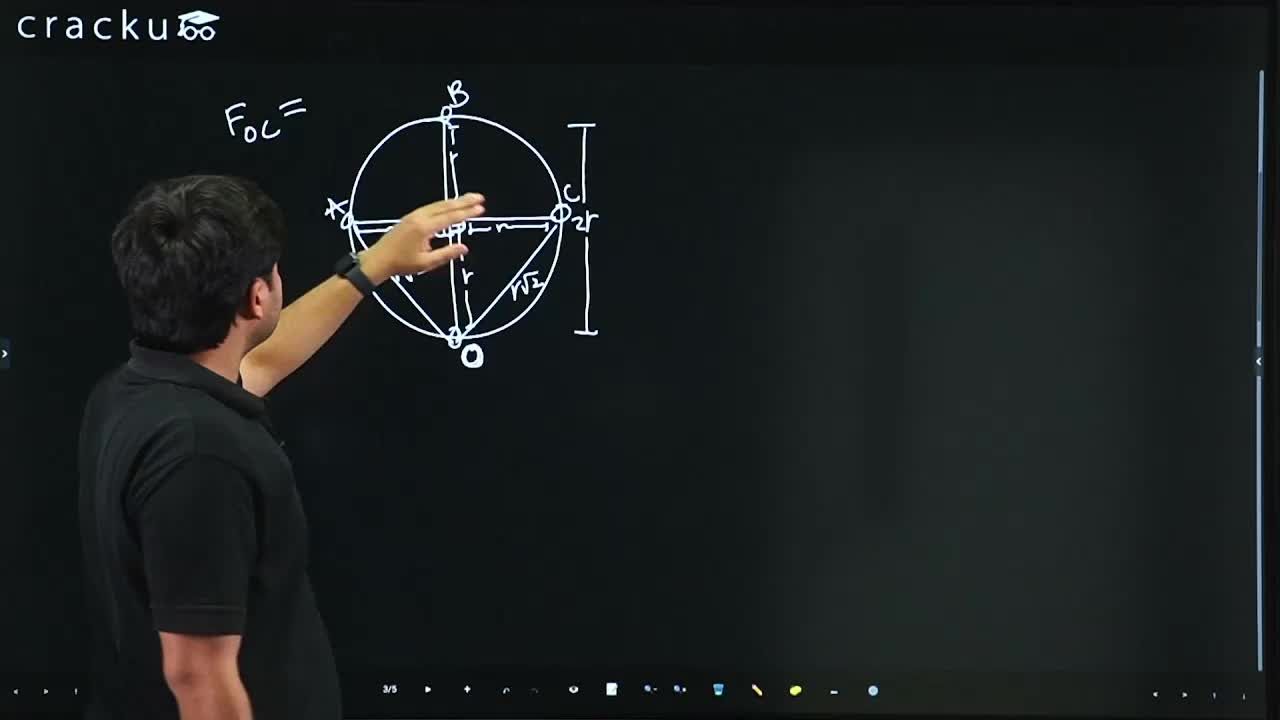
Four identical particles of equal mass of 1 kg are made to move along the circumference of a circle of radius 1 m under the action of their own mutual gravitational attraction. The speed of each particle will be:
Each particle experiences gravitational forces from the other three.
Net Gravitational Force ($$F_{net}$$)
A single particle is pulled by two adjacent particles at a distance $$d = \sqrt{2}R$$ and one opposite particle at a distance $$D = 2R$$. The resultant force acting towards the center is the sum of the components of these forces:
$$F_{net} = 2 \left( \frac{Gm^2}{(\sqrt{2}R)^2} \right) \cos 45^\circ + \frac{Gm^2}{(2R)^2}$$
$$F_{net} = \frac{Gm^2}{R^2} \left( \frac{1}{\sqrt{2}} + \frac{1}{4} \right) = \frac{Gm^2}{R^2} \left( \frac{2\sqrt{2} + 1}{4} \right)$$
This mutual attraction provides the centripetal force required for the circular motion of each particle:
$$\frac{mv^2}{R} = \frac{Gm^2}{R^2} \left( \frac{1 + 2\sqrt{2}}{4} \right)$$
$$v^2 = G \left( \frac{1 + 2\sqrt{2}}{4} \right)$$
$$v = \frac{\sqrt{G(1 + 2\sqrt{2})}}{2}$$
Was this solution helpful?
Click on the Email ☝️ to Watch the Video Solution
Create a FREE account and get:
_1.webp)

Educational materials for JEE preparation

Ask our AI anything

AI can make mistakes. Please verify important information.
AI can make mistakes. Please verify important information.


