
Join Our JEE Preparation Group
Prep with like-minded aspirants; Get access to free daily tests and study material.
Sign in
Please select an account to continue using cracku.in
↓ →
Join Our JEE Preparation Group
Prep with like-minded aspirants; Get access to free daily tests and study material.
Two stars of masses $$m$$ and $$2m$$ at a distance $$d$$ rotate about their common centre of mass in free space. The period of revolution is:
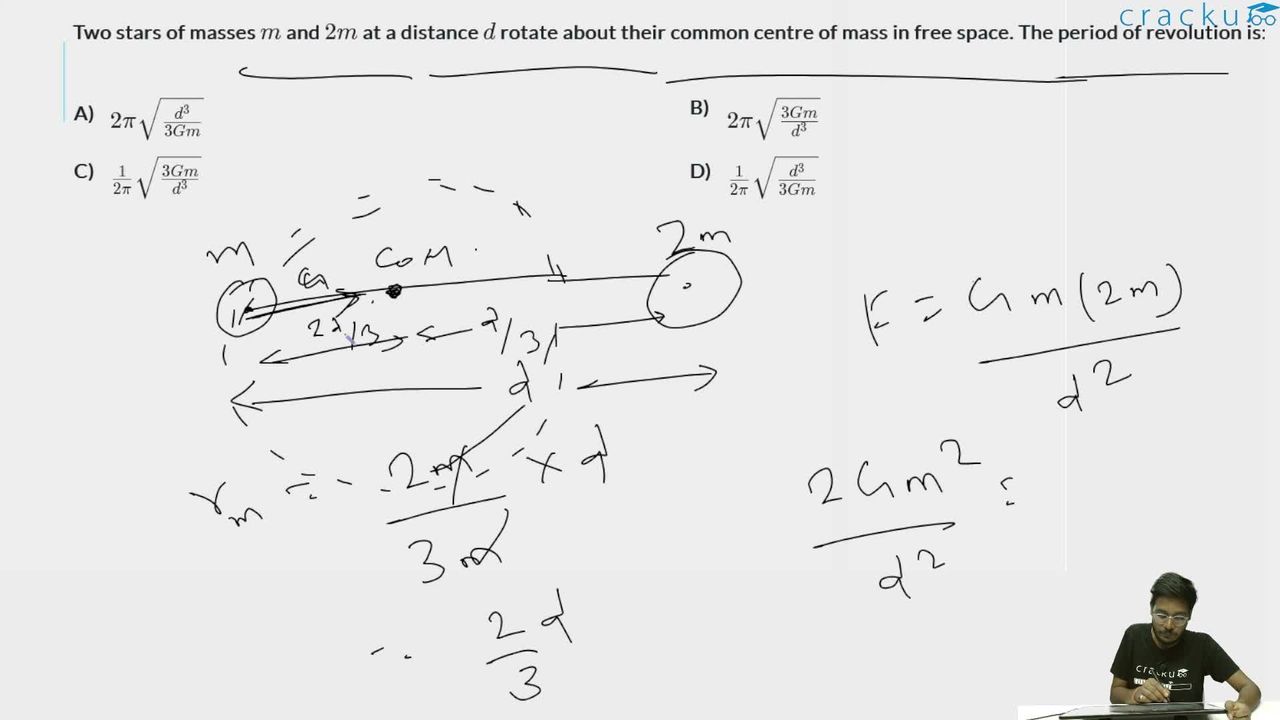
We have two stars of masses $$m$$ and $$2m$$ separated by a distance $$d$$, rotating about their common centre of mass.
The centre of mass divides the line joining them in the inverse ratio of their masses. So the distance of mass $$m$$ from the centre of mass is $$r_1 = \frac{2m \cdot d}{m + 2m} = \frac{2d}{3}$$, and the distance of mass $$2m$$ from the centre of mass is $$r_2 = \frac{m \cdot d}{3m} = \frac{d}{3}$$.
The gravitational force between them provides the centripetal force. For the star of mass $$m$$ orbiting at radius $$r_1 = \frac{2d}{3}$$, we write $$m\omega^2 r_1 = \frac{G \cdot m \cdot 2m}{d^2}$$.
Substituting $$r_1 = \frac{2d}{3}$$, we get $$m\omega^2 \cdot \frac{2d}{3} = \frac{2Gm^2}{d^2}$$.
Simplifying, $$\omega^2 = \frac{2Gm}{d^2} \times \frac{3}{2d} = \frac{3Gm}{d^3}$$.
The period of revolution is $$T = \frac{2\pi}{\omega} = 2\pi\sqrt{\frac{d^3}{3Gm}}$$.
Hence, the correct answer is Option A.
Was this solution helpful?
Click on the Email ☝️ to Watch the Video Solution
Create a FREE account and get:
_1.webp)

Educational materials for JEE preparation

Ask our AI anything

AI can make mistakes. Please verify important information.
AI can make mistakes. Please verify important information.


