
Join Our JEE Preparation Group
Prep with like-minded aspirants; Get access to free daily tests and study material.
Sign in
Please select an account to continue using cracku.in
↓ →
Join Our JEE Preparation Group
Prep with like-minded aspirants; Get access to free daily tests and study material.
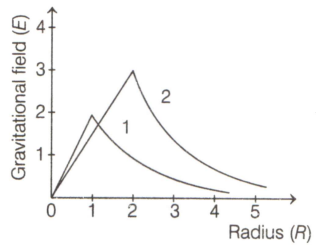
Consider two solid spheres of radii $$R_1 = 1$$ m, $$R_2 = 2$$ m and masses $$M_1$$ and $$M_2$$, respectively. The gravitational field due to sphere (1) and (2) are shown. The value of $$\frac{M_1}{M_2}$$ is:
Minimum Required Theory
$$E_{max} = \frac{GM}{R^2}$$
Step-by-Step Solution
Step 1: Extract data from the graph for Sphere (1)
Using the surface field formula:
$$2 = \frac{GM_1}{(1)^2} \implies 2 = GM_1 \quad \text{--- (Equation 1)}$$
Step 2: Extract data from the graph for Sphere (2)
Using the surface field formula:
$$3 = \frac{GM_2}{(2)^2} \implies 3 = \frac{GM_2}{4} \implies 12 = GM_2 \quad \text{--- (Equation 2)}$$
Step 3: Calculate the ratio $$\frac{M_1}{M_2}$$
Divide Equation 1 by Equation 2:
$$\frac{GM_1}{GM_2} = \frac{2}{12}$$
Cancel the universal gravitational constant $$G$$:
$$\frac{M_1}{M_2} = \frac{1}{6}$$
Final Answer
The value of $$\frac{M_1}{M_2}$$ is $$\frac{1}{6}$$ (or $$0.167$$).
Was this solution helpful?
Click on the Email ☝️ to Watch the Video Solution
Create a FREE account and get:
_1.webp)

Educational materials for JEE preparation

Ask our AI anything

AI can make mistakes. Please verify important information.
AI can make mistakes. Please verify important information.
