
Join Our JEE Preparation Group
Prep with like-minded aspirants; Get access to free daily tests and study material.
Sign in
Please select an account to continue using cracku.in
↓ →
Join Our JEE Preparation Group
Prep with like-minded aspirants; Get access to free daily tests and study material.
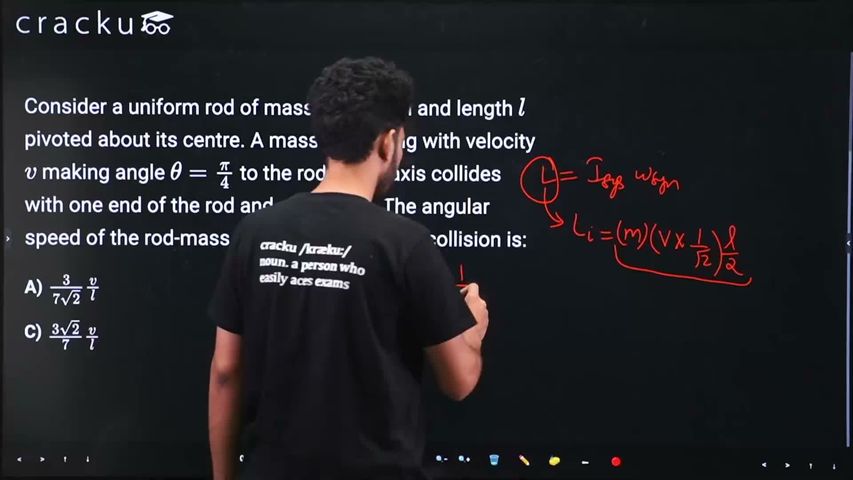
Consider a uniform rod of mass $$M = 4$$ m and length $$l$$ pivoted about its centre. A mass $$m$$ moving with velocity $$v$$ making angle $$\theta = \frac{\pi}{4}$$ to the rod's long axis collides with one end of the rod and sticks to it. The angular speed of the rod-mass system just after the collision is:
We begin by noting that the rod is pivoted at its centre, so any torque exerted by the pivot has zero moment arm and the external torque about the pivot is zero. Hence, the angular momentum about the pivot is conserved during the collision.
The mass of the rod is given as $$M = 4m$$ and its length is $$l$$. The smaller mass is $$m$$ and it approaches one end of the rod with speed $$v$$, making an angle $$\theta = \dfrac{\pi}{4}$$ (that is, $$45^{\circ}$$) with the long axis of the rod.
First, we calculate the initial angular momentum of the incoming particle about the pivot:
For a point particle, the magnitude of angular momentum about a reference point is $$L = rp\sin\phi$$, where $$r$$ is the distance from the reference point to the line of action of the particle, $$p$$ is the linear momentum magnitude, and $$\phi$$ is the angle between the position vector and the momentum vector.
Here, the particle hits the extreme end of the rod, so the distance from the pivot (centre) to the point of impact is $$r = \dfrac{l}{2}$$. The linear momentum magnitude of the particle is $$p = mv$$. The position vector from pivot to end is along the rod’s axis, and the velocity vector makes an angle $$\theta = 45^{\circ}$$ with that axis, so $$\phi = \theta = 45^{\circ}$$. Therefore
$$ L_{\text{initial}} = \left(\dfrac{l}{2}\right)\, (mv)\, \sin\theta = \left(\dfrac{l}{2}\right)\,(mv)\,\sin\!\left(\dfrac{\pi}{4}\right) = \left(\dfrac{l}{2}\right)\,(mv)\,\dfrac{1}{\sqrt{2}} = \dfrac{mvl}{2\sqrt{2}}. $$
Next, we calculate the moment of inertia of the combined system (rod + particle) about the pivot after the particle sticks to the end:
1. The moment of inertia of a uniform rod of mass $$M$$ and length $$l$$ about an axis through its centre and perpendicular to its length is given by $$ I_{\text{rod}} = \dfrac{1}{12} M l^{2}. $$ Since $$M = 4m$$, we have $$ I_{\text{rod}} = \dfrac{1}{12}\,(4m)\,l^{2} = \dfrac{1}{3} m l^{2}. $$
2. The moment of inertia of the point mass $$m$$ once it sticks to the end is $$ I_{\text{mass}} = mr^{2} = m\!\left(\dfrac{l}{2}\right)^{2} = \dfrac{m l^{2}}{4}. $$
Therefore, the total moment of inertia of the rod-mass system just after the collision is
$$ I_{\text{total}} = I_{\text{rod}} + I_{\text{mass}} = \dfrac{1}{3} m l^{2} + \dfrac{1}{4} m l^{2} = \left(\dfrac{4}{12} + \dfrac{3}{12}\right) m l^{2} = \dfrac{7}{12} m l^{2}. $$
Since angular momentum is conserved, we set the initial angular momentum equal to the final angular momentum:
$$ L_{\text{initial}} = L_{\text{final}} \;\Longrightarrow\; \dfrac{mvl}{2\sqrt{2}} = I_{\text{total}}\;\omega. $$
Substituting $$I_{\text{total}} = \dfrac{7}{12} m l^{2}$$ we get
$$ \dfrac{mvl}{2\sqrt{2}} = \left(\dfrac{7}{12} m l^{2}\right) \omega. $$
Now we solve for $$\omega$$ step by step:
$$ \omega = \dfrac{\dfrac{mvl}{2\sqrt{2}}}{\dfrac{7}{12} m l^{2}} = \dfrac{m v l}{2\sqrt{2}} \times \dfrac{12}{7 m l^{2}} = \dfrac{12}{2\sqrt{2}} \times \dfrac{v}{7l} = \dfrac{6}{\sqrt{2}} \times \dfrac{v}{7l}. $$
We simplify $$\dfrac{6}{\sqrt{2}}$$ by rationalising the denominator:
$$ \dfrac{6}{\sqrt{2}} = \dfrac{6\sqrt{2}}{2} = 3\sqrt{2}. $$
Hence
$$ \omega = \dfrac{3\sqrt{2}}{7}\,\dfrac{v}{l}. $$
This expression matches Option C.
Hence, the correct answer is Option C.
Was this solution helpful?
Click on the Email ☝️ to Watch the Video Solution
Create a FREE account and get:
_1.webp)

Educational materials for JEE preparation

Ask our AI anything

AI can make mistakes. Please verify important information.
AI can make mistakes. Please verify important information.
