
Join Our JEE Preparation Group
Prep with like-minded aspirants; Get access to free daily tests and study material.
Sign in
Please select an account to continue using cracku.in
↓ →
Join Our JEE Preparation Group
Prep with like-minded aspirants; Get access to free daily tests and study material.
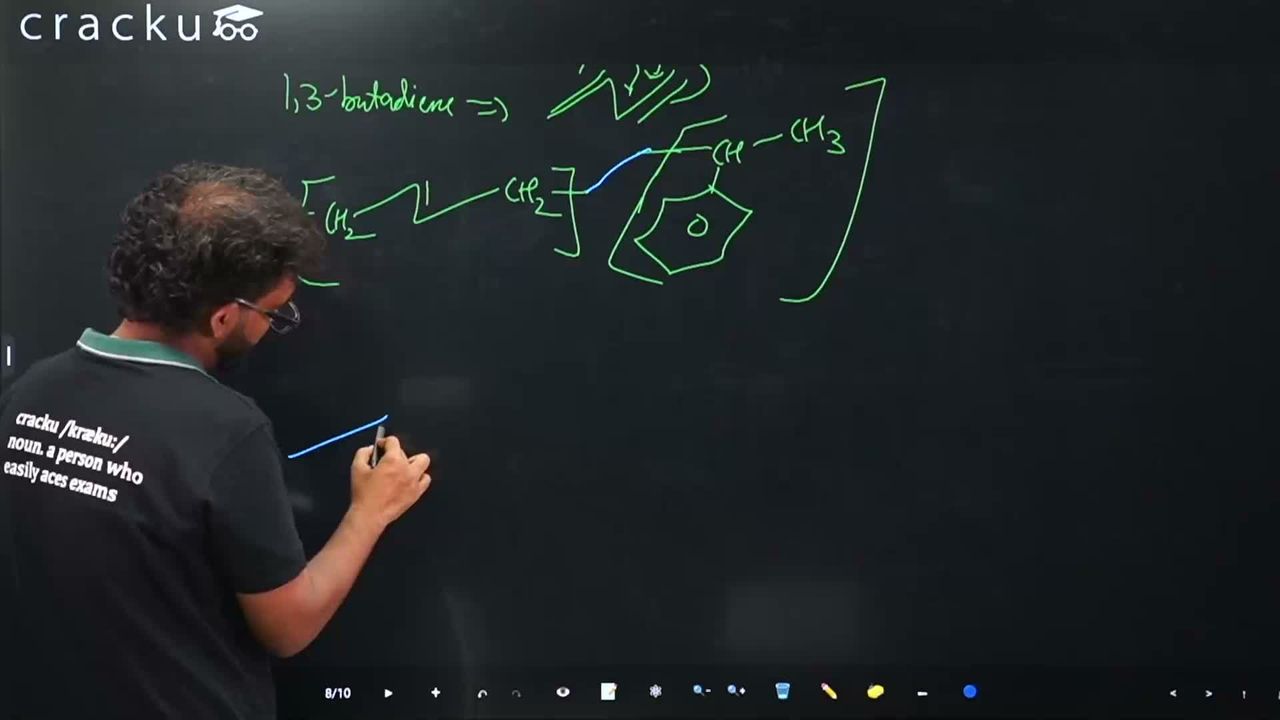
Buna-S is the most common synthetic rubber. The name tells everything about its composition:
• “Bu” comes from $$1,3$$-butadiene
• “Na” indicates that sodium metal was the first catalyst used for its polymerisation
• “S” stands for styrene
Hence Buna-S is obtained by copolymerising $$1,3$$-butadiene\,(approx. $$75\%$$) with styrene\,(approx. $$25\%$$).
The structural repeat unit of the copolymer is therefore made by alternating segments derived from the two monomers:
$$\Bigl[\,CH_2\;{\text{-}}\;CH{=}\!CH\;{\text{-}}\;CH_2\,\Bigr]_x \;\;\;\Bigl[\,CH_2\;{\text{-}}\;CH(C_6H_5)\,\Bigr]_y$$
Any option that shows these two fragments—one with conjugated double bond units from butadiene and the other with a phenyl-substituted $$CH$$ unit from styrene—joined into the same main chain is the correct representation.
Among the four drawings given in the question, Option B (Option 2) is the only one that displays a polymer chain containing both
$$\;-\!CH_2-CH=CH-CH_2-\;$$ and $$\;-\!CH_2-CH(C_6H_5)-\;$$ links. Therefore,
Answer: Option B (Option 2).
Was this solution helpful?
Click on the Email ☝️ to Watch the Video Solution
Create a FREE account and get:
_1.webp)

Educational materials for JEE preparation

Ask our AI anything

AI can make mistakes. Please verify important information.
AI can make mistakes. Please verify important information.


