
Join Our JEE Preparation Group
Prep with like-minded aspirants; Get access to free daily tests and study material.
Sign in
Please select an account to continue using cracku.in
↓ →
Join Our JEE Preparation Group
Prep with like-minded aspirants; Get access to free daily tests and study material.
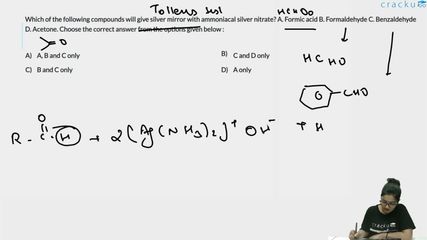
Which of the following compounds will give silver mirror with ammoniacal silver nitrate? A. Formic acid B. Formaldehyde C. Benzaldehyde D. Acetone. Choose the correct answer from the options given below :
We need to identify which compounds give a silver mirror test (Tollens' test) with ammoniacal silver nitrate ($$[Ag(NH_3)_2]^+$$).
Tollens' reagent (ammoniacal silver nitrate) acts as a mild oxidising agent that oxidises aldehydes and certain other reducing compounds while itself being reduced. In this process silver ions ($$Ag^+$$) are reduced to metallic silver ($$Ag$$), which deposits as a mirror on the test tube wall:
$$RCHO + 2[Ag(NH_3)_2]^+ + 2OH^- \rightarrow RCOO^- + 2Ag \downarrow + 4NH_3 + H_2O$$
Formic acid has the structure $$H-\underset{\displaystyle \|}{\overset{\displaystyle O}{C}}-OH$$. Unlike other carboxylic acids, it contains an aldehyde-like $$H-C=O$$ group in addition to the $$-OH$$ group. This structural feature allows it to act as a reducing agent, so formic acid gives a positive silver mirror test.
Formaldehyde (HCHO) is an aldehyde and readily reduces Tollens' reagent. It is oxidised all the way to formate or carbonate because both hydrogen atoms on the carbon can be oxidised, and thus formaldehyde gives a positive silver mirror test.
Benzaldehyde ($$C_6H_5CHO$$) is an aromatic aldehyde containing the $$-CHO$$ group, and all aldehydes give a positive Tollens' test whether they are aliphatic or aromatic. Consequently, benzaldehyde gives a positive silver mirror test.
Acetone ($$CH_3COCH_3$$) is a ketone that lacks the $$-CHO$$ group and is not easily oxidised by the mild oxidising agent in Tollens' reagent. Therefore, acetone does not give a silver mirror test.
Consequently, formic acid, formaldehyde, and benzaldehyde give a positive silver mirror test, whereas acetone does not. The correct answer is Option 1: A, B and C only.
Was this solution helpful?
Click on the Email ☝️ to Watch the Video Solution
Create a FREE account and get:
_1.webp)

Educational materials for JEE preparation

Ask our AI anything

AI can make mistakes. Please verify important information.
AI can make mistakes. Please verify important information.
