
Join Our JEE Preparation Group
Prep with like-minded aspirants; Get access to free daily tests and study material.
Sign in
Please select an account to continue using cracku.in
↓ →
Join Our JEE Preparation Group
Prep with like-minded aspirants; Get access to free daily tests and study material.
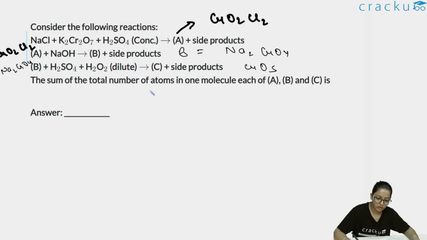
Consider the following reactions:
NaCl + K$$_2$$Cr$$_2$$O$$_7$$ + H$$_2$$SO$$_4$$ (Conc.) $$\rightarrow$$ (A) + side products
(A) + NaOH $$\rightarrow$$ (B) + side products
(B) + H$$_2$$SO$$_4$$ + H$$_2$$O$$_2$$ (dilute) $$\rightarrow$$ (C) + side products
The sum of the total number of atoms in one molecule each of (A), (B) and (C) is
Correct Answer: 18
We have first reaction involving common salt, sodium chloride, with potassium dichromate and concentrated sulphuric acid.
From qualitative inorganic analysis it is well-known that $$\text{Cl}^-$$ in the presence of $$\text{K}_2\text{Cr}_2\text{O}_7$$ and conc. $$\text{H}_2\text{SO}_4$$ produces deep-red vapours of chromyl chloride. Writing the balanced equation,
$$4\,\text{NaCl}+\,\text{K}_2\text{Cr}_2\text{O}_7+3\,\text{H}_2\text{SO}_4 \;\longrightarrow\;2\,\text{CrO}_2\text{Cl}_2+\,\text{K}_2\text{SO}_4+2\,\text{Na}_2\text{SO}_4+3\,\text{H}_2\text{O}$$
The substance asked for is the red vapour $$\text{CrO}_2\text{Cl}_2$$, so
$$(A)=\text{CrO}_2\text{Cl}_2\;(\text{chromyl chloride}).$$
Counting the atoms present in one molecule of (A):
$$\text{Cr}=1,\;\text{O}=2,\;\text{Cl}=2\;\Longrightarrow\;1+2+2=5\text{ atoms.}$$
Now (A) is treated with aqueous sodium hydroxide. The standard reaction is
$$\text{CrO}_2\text{Cl}_2+4\,\text{NaOH}\;\longrightarrow\;\text{Na}_2\text{CrO}_4+2\,\text{NaCl}+2\,\text{H}_2\text{O}.$$
The yellow compound obtained is sodium chromate, therefore
$$(B)=\text{Na}_2\text{CrO}_4\;(\text{sodium chromate}).$$
Next, (B) is treated with dilute $$\text{H}_2\text{SO}_4$$ and hydrogen peroxide. In acidic medium the chromate ion $$\text{CrO}_4^{2-}$$ reacts with $$\text{H}_2\text{O}_2$$ to give the deep-blue peroxo compound generally written as $$\text{CrO}_5$$. A simplified ionic equation is
$$\text{CrO}_4^{2-}+4\,\text{H}^++\text{H}_2\text{O}_2\;\longrightarrow\;\text{CrO}_5+3\,\text{H}_2\text{O}.$$
Because the sodium ions become spectator ions after acidification, the substance actually isolated is
$$(C)=\text{CrO}_5\;(\text{peroxochromic acid, transient}).$$
Counting atoms in one molecule of (B):
$$\text{Na}=2,\;\text{Cr}=1,\;\text{O}=4\;\Longrightarrow\;2+1+4=7\text{ atoms.}$$
Counting atoms in one molecule of (C):
$$\text{Cr}=1,\;\text{O}=5\;\Longrightarrow\;1+5=6\text{ atoms.}$$
Finally, summing the total number of atoms contained in one molecule each of (A), (B) and (C):
$$5\;(\text{from }A)+7\;(\text{from }B)+6\;(\text{from }C)=18.$$
So, the answer is $$18$$.
Was this solution helpful?
Click on the Email ☝️ to Watch the Video Solution
Create a FREE account and get:
_1.webp)

Educational materials for JEE preparation

Ask our AI anything

AI can make mistakes. Please verify important information.
AI can make mistakes. Please verify important information.
