
Join Our JEE Preparation Group
Prep with like-minded aspirants; Get access to free daily tests and study material.
Sign in
Please select an account to continue using cracku.in
↓ →
Join Our JEE Preparation Group
Prep with like-minded aspirants; Get access to free daily tests and study material.
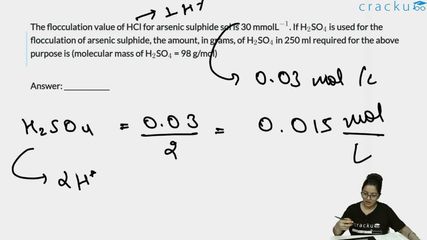
The flocculation value of HCl for arsenic sulphide sol is 30 mmolL$$^{-1}$$. If H$$_2$$SO$$_4$$ is used for the flocculation of arsenic sulphide, the amount, in grams, of H$$_2$$SO$$_4$$ in 250 ml required for the above purpose is (molecular mass of H$$_2$$SO$$_4$$ = 98 g/mol)
Correct Answer: 0.36
We have been told that the flocculation value of HCl for the arsenic-sulphide sol is $$30\;\text{mmol L}^{-1}$$. By definition, a flocculation value tells us the minimum concentration of electrolyte (here, HCl) that must be present in 1 litre of the sol to bring about coagulation. Thus, per litre we need
$$30\;\text{mmol} = 30 \times 10^{-3}\;\text{mol} = 0.030\;\text{mol}$$
of HCl. Each molecule of HCl furnishes exactly one $$\text{H}^+$$ ion, so the required concentration of coagulating hydrogen ions is also
$$[\text{H}^+] = 0.030\;\text{mol L}^{-1}$$
Now we intend to supply the same $$\text{H}^+$$ ions through $$\text{H}_2\text{SO}_4$$ instead of HCl. First, we recall the dissociation equation of sulphuric acid in aqueous solution:
$$\text{H}_2\text{SO}_4 \;\longrightarrow\; 2\text{H}^+ \;+\; \text{SO}_4^{2-}$$
From this equation we see that one mole of $$\text{H}_2\text{SO}_4$$ generates two moles of $$\text{H}^+$$ ions. Therefore, to provide the same $$0.030$$ mol of $$\text{H}^+$$ ions per litre, the molarity of $$\text{H}_2\text{SO}_4$$ required is half of 0.030 mol L-1:
$$M_{\text{H}_2\text{SO}_4} \;=\;\frac{0.030}{2}\;\text{mol L}^{-1} \;=\; 0.015\;\text{mol L}^{-1}$$
Next we note that the problem asks for the quantity of acid needed for a 250 mL (i.e. 0.250 L) sample of the sol. Using the definition of molarity,
$$\text{moles} = M \times V$$
we find the moles of $$\text{H}_2\text{SO}_4$$ required:
$$n_{\text{H}_2\text{SO}_4} \;=\; 0.015\;\text{mol L}^{-1} \times 0.250\;\text{L} = 0.00375\;\text{mol}$$
Finally, to convert moles to mass we apply the basic relation
$$\text{mass} = \text{moles} \times \text{molar mass}$$
The molar mass of $$\text{H}_2\text{SO}_4$$ is given as $$98\;\text{g mol}^{-1}$$, so
$$m = 0.00375\;\text{mol} \times 98\;\text{g mol}^{-1} = 0.3675\;\text{g}$$
Writing the answer to two significant figures (as generally done with laboratory quantities), we obtain
$$m \approx 0.36\;\text{g}$$
So, the answer is $$0.36\ \text{g}$$.
Was this solution helpful?
Click on the Email ☝️ to Watch the Video Solution
Create a FREE account and get:
_1.webp)

Educational materials for JEE preparation

Ask our AI anything

AI can make mistakes. Please verify important information.
AI can make mistakes. Please verify important information.
