
Join Our JEE Preparation Group
Prep with like-minded aspirants; Get access to free daily tests and study material.
Sign in
Please select an account to continue using cracku.in
↓ →
Join Our JEE Preparation Group
Prep with like-minded aspirants; Get access to free daily tests and study material.
3 g of acetic acid is added to 250 mL of 0.1 M HCl and the solution made up to 500 mL. To 20 mL of this solution $$\frac{1}{2}$$ mL of 5M NaOH is added. The pH of the solution is
[Given: pKa of acetic acid = 4.75, molar mass of acetic acid 60 g/mol, log 3 = 0.4771, Neglect any changes in volume]
Correct Answer: 5.22
We have to follow the mole concept throughout, because moles do not change on dilution.
First, calculate the moles of each reagent placed in the original 500 mL solution.
For acetic acid:
The molar mass of acetic acid is $$60\ \text{g mol}^{-1}$$, hence
$$ n_{\text{CH}_{3}\text{COOH}}=\frac{3\ \text{g}}{60\ \text{g mol}^{-1}}=0.05\ \text{mol}. $$
For hydrochloric acid:
The concentration is $$0.1\ \text{M}$$ and the volume is $$250\ \text{mL}=0.250\ \text{L}$$, so
$$ n_{\text{HCl}}=0.1\ \text{mol L}^{-1}\times0.250\ \text{L}=0.025\ \text{mol}. $$
These two acids are dissolved together and the total volume is then made up to $$500\ \text{mL}=0.500\ \text{L}$$. The moles remain the same, only the concentrations change.
Thus, in the 500 mL solution
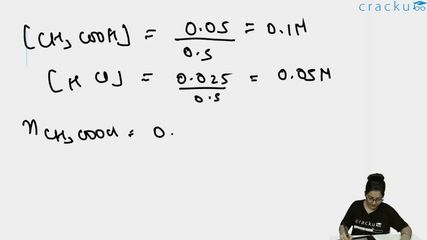
$$ [\text{CH}_{3}\text{COOH}]=\frac{0.05\ \text{mol}}{0.500\ \text{L}}=0.10\ \text{M}, $$
$$ [\text{H}^+]_{\text{(from HCl)}}=[\text{HCl}]=\frac{0.025\ \text{mol}}{0.500\ \text{L}}=0.05\ \text{M}. $$
Now 20 mL of this mixed solution is taken. Converting this portion back to moles:
Volume chosen: $$20\ \text{mL}=0.020\ \text{L}.$$ So,
$$ n_{\text{CH}_{3}\text{COOH,\ taken}}=0.10\ \text{mol L}^{-1}\times0.020\ \text{L}=0.002\ \text{mol}, $$
$$ n_{\text{HCl,\ taken}}=0.05\ \text{mol L}^{-1}\times0.020\ \text{L}=0.001\ \text{mol}. $$
Next, $$\dfrac12\ \text{mL}=0.0005\ \text{L}$$ of $$5\ \text{M}$$ NaOH is added. The moles of NaOH added are
$$ n_{\text{NaOH}}=5\ \text{mol L}^{-1}\times0.0005\ \text{L}=0.0025\ \text{mol}. $$
Reaction sequence: strong base first neutralises the strong acid (HCl), then whatever remains of the base neutralises the weak acid (acetic acid).
Step 1 - neutralisation of HCl:
$$ \text{HCl}+\text{NaOH}\longrightarrow\text{NaCl}+ \text{H}_2\text{O} $$
$$ \text{Initial moles:}\quad n_{\text{HCl}}=0.001,\; n_{\text{NaOH}}=0.0025 $$
HCl is the limiting reagent, so it is completely consumed:
$$ n_{\text{NaOH,\,left}}=0.0025-0.001=0.0015\ \text{mol}. $$
Step 2 - the leftover NaOH reacts with acetic acid:
$$ \text{CH}_3\text{COOH}+\text{OH}^- \longrightarrow \text{CH}_3\text{COO}^-+\text{H}_2\text{O} $$
$$ \text{Initial moles:}\quad n_{\text{CH}_{3}\text{COOH}}=0.002,\; n_{\text{OH}^-}=0.0015 $$
The hydroxide ion is again the limiting species here, so
$$ n_{\text{CH}_{3}\text{COOH,\,left}}=0.002-0.0015=0.0005\ \text{mol}, $$
$$ n_{\text{CH}_{3}\text{COO}^-}=0.0015\ \text{mol}. $$
After these reactions, the mixture contains a weak acid (acetic acid) and its conjugate base (acetate). This is a buffer. We can therefore use the Henderson-Hasselbalch equation, which is
$$ \text{pH}= \text{p}K_a + \log\left(\frac{[\text{A}^-]}{[\text{HA}]}\right). $$
The total volume change caused by adding 0.5 mL of NaOH to 20 mL is neglected as instructed; effectively the volume remains 20 mL. Since the same volume is common to both the numerator and denominator in the ratio $$\frac{[\text{A}^-]}{[\text{HA}]}$$, we can use the mole ratio directly:
$$ \frac{[\text{A}^-]}{[\text{HA}]}=\frac{0.0015}{0.0005}=3. $$
Given $$\text{p}K_a=4.75$$ and $$\log 3=0.4771$$, we obtain
$$ \text{pH}=4.75+\log 3=4.75+0.4771=5.2271\approx5.22. $$
So, the answer is $$5.22$$.
Was this solution helpful?
Click on the Email ☝️ to Watch the Video Solution
Create a FREE account and get:
_1.webp)

Educational materials for JEE preparation

Ask our AI anything

AI can make mistakes. Please verify important information.
AI can make mistakes. Please verify important information.
