
Join Our JEE Preparation Group
Prep with like-minded aspirants; Get access to free daily tests and study material.
Sign in
Please select an account to continue using cracku.in
↓ →
Join Our JEE Preparation Group
Prep with like-minded aspirants; Get access to free daily tests and study material.
The standard heat of formation $$(\Delta_f H_{298}^0)$$ of ethane (in kJ/mol), if the heat of combustion of ethane, hydrogen and graphite are $$-1560$$, $$-393.5$$ and $$-286$$ kJ/mol, respectively is
Correct Answer: -192
We have to find the standard enthalpy of formation of ethane, that is, the enthalpy change for the reaction
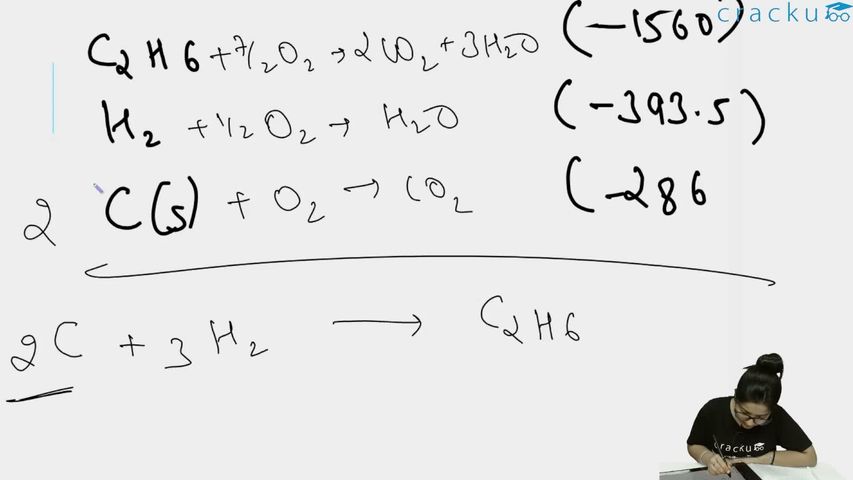
$$$2\,\text{C (graphite)} + 3\,\text{H}_2(g) \;\longrightarrow\; \text{C}_2\text{H}_6(g)\qquad \Delta_f H_{298}^0\;=?$$$
The data supplied are the standard heats of combustion (all at 298 K):
$$$\begin{aligned} \text{C}_2\text{H}_6(g) &+ \tfrac72\,\text{O}_2(g) \;\longrightarrow\; 2\,\text{CO}_2(g) + 3\,\text{H}_2\text{O}(l) &&\Delta_c H_{298}^0 = -1560\ \text{kJ mol}^{-1}\\[4pt] \text{H}_2(g) &+ \tfrac12\,\text{O}_2(g) \;\longrightarrow\; \text{H}_2\text{O}(l) &&\Delta_c H_{298}^0 = -393.5\ \text{kJ mol}^{-1}\\[4pt] \text{C (graphite)} &+ \text{O}_2(g) \;\longrightarrow\; \text{CO}_2(g) &&\Delta_c H_{298}^0 = -286\ \text{kJ mol}^{-1} \end{aligned}$$$
To apply Hess’s law we first write the combustion of the elements that actually appear in the sought formation reaction.
The combustion of two moles of graphite is
$$$2\,\text{C (graphite)} + 2\,\text{O}_2(g) \;\longrightarrow\; 2\,\text{CO}_2(g)$$$
Using the tabulated value, its enthalpy change is
$$\Delta = 2 \times (-286)\ \text{kJ} = -572\ \text{kJ}$$
Next, the combustion of three moles of hydrogen is
$$$3\,\text{H}_2(g) + \tfrac32\,\text{O}_2(g) \;\longrightarrow\; 3\,\text{H}_2\text{O}(l)$$$
Its enthalpy change equals
$$$\Delta = 3 \times (-393.5)\ \text{kJ} = -1180.5\ \text{kJ}$$$
Adding these two combustions, the overall enthalpy when the elements burn is
$$$\begin{aligned} \Delta H_{\text{(elements burn)}} &= -572\ \text{kJ} + (-1180.5\ \text{kJ})\\ &= -1752.5\ \text{kJ} \end{aligned}$$$
Now, for ethane there is only one combustion equation with its own heat:
$$$\text{C}_2\text{H}_6(g) + \tfrac72\,\text{O}_2(g) \;\longrightarrow\; 2\,\text{CO}_2(g) + 3\,\text{H}_2\text{O}(l)\qquad \Delta_c H^0 = -1560\ \text{kJ}$$$
We invoke Hess’s law. Consider two alternative routes that take the elements to the same final combustion products 2 CO2(g) + 3 H2O(l):
Route 1: elements → C2H6(g) (enthalpy change $$\Delta_f H_{298}^0$$), then ethane burns (enthalpy change $$-1560\ \text{kJ}$$).
Route 2: elements burn directly (enthalpy change $$-1752.5\ \text{kJ}$$).
Because the final states are identical, the overall enthalpy changes of the two routes must be equal. Hence,
$$$\Delta_f H_{298}^0 + (-1560\ \text{kJ}) = -1752.5\ \text{kJ}$$$
Now we solve for $$\Delta_f H_{298}^0$$ step by step:
$$$\begin{aligned} \Delta_f H_{298}^0 &= -1752.5\ \text{kJ} + 1560\ \text{kJ}\\[6pt] &= -192.5\ \text{kJ} \end{aligned}$$$
Owing to the precision of the given data, this rounds to
$$$\Delta_f H_{298}^0(\text{C}_2\text{H}_6) \;\approx\; -192\ \text{kJ mol}^{-1}$$$
Hence, the correct answer is Option D.
Was this solution helpful?
Click on the Email ☝️ to Watch the Video Solution
Create a FREE account and get:
_1.webp)

Educational materials for JEE preparation

Ask our AI anything

AI can make mistakes. Please verify important information.
AI can make mistakes. Please verify important information.
