Join Our JEE Preparation Group
Prep with like-minded aspirants; Get access to free daily tests and study material.
Sign in
Please select an account to continue using cracku.in
↓ →
Join Our JEE Preparation Group
Prep with like-minded aspirants; Get access to free daily tests and study material.
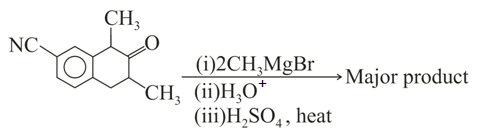
First, the two equivalents of the Grignard reagent (CH₃MgBr) react with the two separate electrophilic centers in the starting molecule.
One equivalent of CH₃MgBr nucleophilically attacks the ketone carbon on the non-aromatic ring. Following the acidic workup (H₃O⁺), this functional group is converted into a tertiary alcohol, placing a new methyl group at that position.
The second equivalent of CH₃MgBr attacks the nitrile group (-CN) located on the aromatic ring. The acidic workup hydrolyzes the resulting imine intermediate, converting the nitrile group into a methyl ketone, also known as an acetyl group (-COCH₃).
Finally, the addition of sulfuric acid (H₂SO₄) and heat induces the acid-catalyzed dehydration of the newly formed tertiary alcohol. A molecule of water is eliminated to create a carbon-carbon double bond. The elimination occurs preferentially between the alcohol carbon and the adjacent benzylic carbon (the carbon directly attached to the aromatic ring). This specific pathway is favored because it yields an alkene that is in direct conjugation with the aromatic benzene ring, providing significant thermodynamic stability through resonance.
Thus, the correct option is C.
Create a FREE account and get:
_1.webp)

Educational materials for JEE preparation

Ask our AI anything

AI can make mistakes. Please verify important information.
AI can make mistakes. Please verify important information.