
Join Our JEE Preparation Group
Prep with like-minded aspirants; Get access to free daily tests and study material.
Sign in
Please select an account to continue using cracku.in
↓ →
Join Our JEE Preparation Group
Prep with like-minded aspirants; Get access to free daily tests and study material.
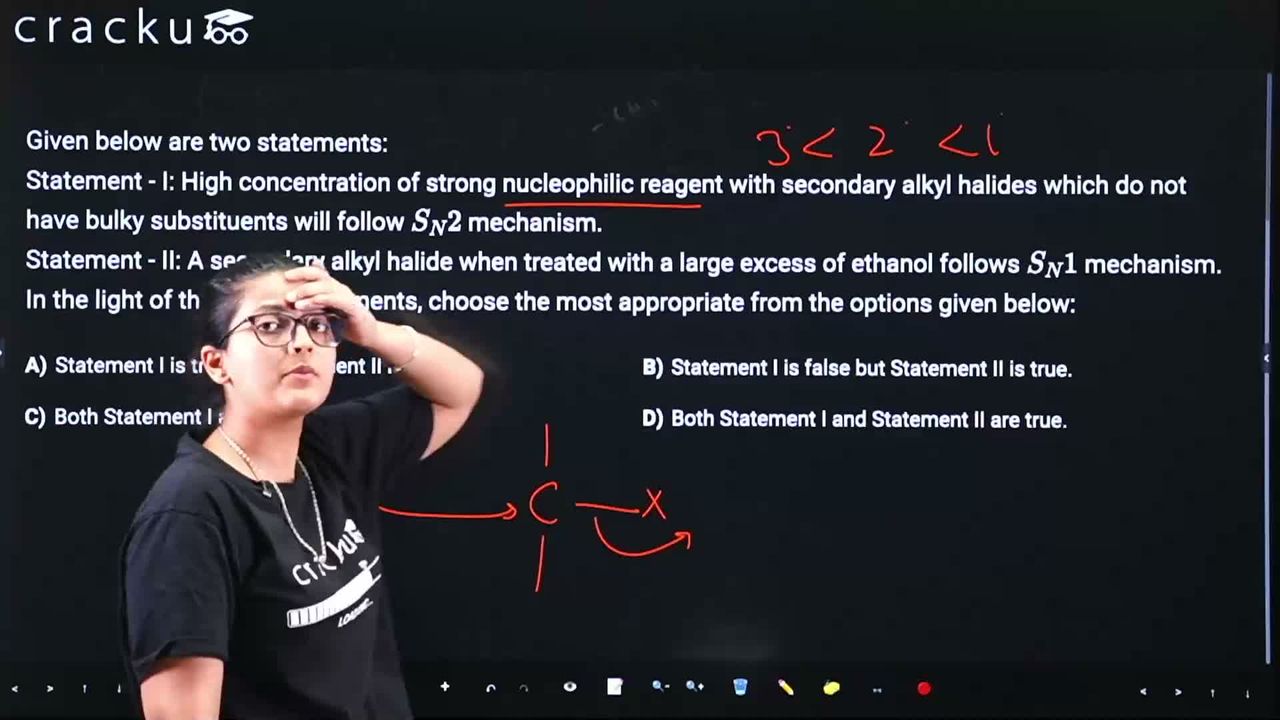
Given below are two statements:
Statement - I: High concentration of strong nucleophilic reagent with secondary alkyl halides which do not have bulky substituents will follow $$S_N2$$ mechanism.
Statement - II: A secondary alkyl halide when treated with a large excess of ethanol follows $$S_N1$$ mechanism.
In the light of the above statements, choose the most appropriate from the options given below:
We need to evaluate both statements about nucleophilic substitution mechanisms with secondary alkyl halides.
Background - Key factors determining S$$_N$$1 vs S$$_N$$2 mechanism:
1. S$$_N$$2 mechanism is favored by: strong nucleophile, high nucleophile concentration, polar aprotic solvent, primary or secondary substrate without bulky groups.
2. S$$_N$$1 mechanism is favored by: weak nucleophile, polar protic solvent, stable carbocation (tertiary > secondary), and the rate depends only on the substrate concentration.
Analysis of Statement I:
"High concentration of strong nucleophilic reagent with secondary alkyl halides which do not have bulky substituents will follow S$$_N$$2 mechanism."
In S$$_N$$2, the rate law is: $$\text{Rate} = k[\text{substrate}][\text{nucleophile}]$$. A high concentration of a strong nucleophile increases the rate of the S$$_N$$2 pathway. Secondary alkyl halides can undergo both S$$_N$$1 and S$$_N$$2, but with a strong nucleophile at high concentration and no steric hindrance (no bulky substituents), the S$$_N$$2 pathway dominates because the nucleophile can effectively attack the electrophilic carbon via backside attack.
Therefore, Statement I is TRUE.
Analysis of Statement II:
"A secondary alkyl halide when treated with a large excess of ethanol follows S$$_N$$1 mechanism."
Ethanol ($$C_2H_5OH$$) is a weak nucleophile and a polar protic solvent. In S$$_N$$1, the rate-determining step is the formation of the carbocation: $$R\text{-}X \rightarrow R^+ + X^-$$. A polar protic solvent like ethanol stabilizes both the carbocation intermediate and the leaving group through solvation. Since ethanol is a weak nucleophile (it does not strongly drive S$$_N$$2), and it acts as a polar protic solvent that stabilizes the carbocation, the reaction follows the S$$_N$$1 pathway. The large excess of ethanol means it acts primarily as the solvent rather than as a concentrated nucleophile driving a bimolecular mechanism.
Therefore, Statement II is TRUE.
Since both statements are true, the correct answer is Option (4): Both Statement I and Statement II are true.
Was this solution helpful?
Click on the Email ☝️ to Watch the Video Solution
Create a FREE account and get:
_1.webp)

Educational materials for JEE preparation

Ask our AI anything

AI can make mistakes. Please verify important information.
AI can make mistakes. Please verify important information.
