
Join Our JEE Preparation Group
Prep with like-minded aspirants; Get access to free daily tests and study material.
Sign in
Please select an account to continue using cracku.in
↓ →
Join Our JEE Preparation Group
Prep with like-minded aspirants; Get access to free daily tests and study material.
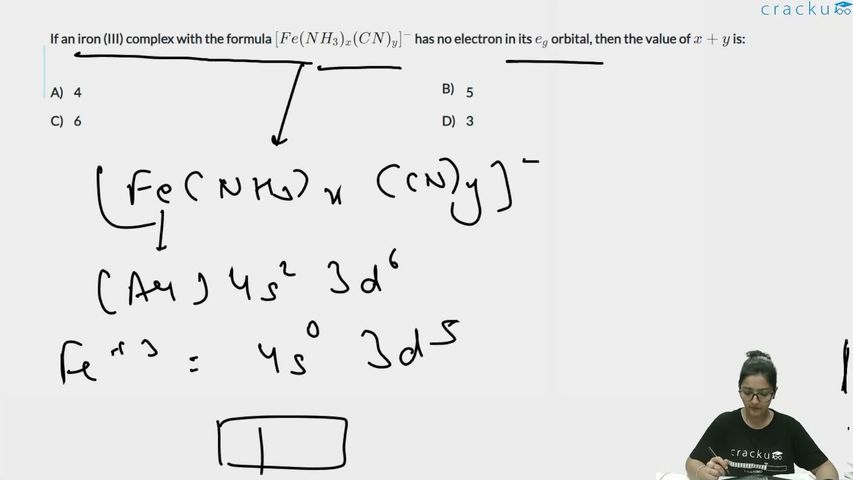
If an iron (III) complex with the formula $$[Fe(NH_3)_x(CN)_y]^-$$ has no electron in its $$e_g$$ orbital, then the value of $$x + y$$ is:
The given complex is $$[\,Fe(NH_3)_x(CN)_y\,]^{-}$$ and the metal ion is iron(III), that is $$Fe^{3+}$$. For the d-electron count:
$$Fe \;(Z = 26)\; \Rightarrow \; Fe^{3+} : [\,Ar\,]\,3d^{5}$$ Hence the metal centre is a $$d^{5}$$ system.
In an octahedral field the five d-orbitals split into the lower-energy $$t_{2g}$$ set and the higher-energy $$e_{g}$$ set. If a $$d^{5}$$ ion has no electron in its $$e_{g}$$ orbitals, all five electrons must be paired in the lower $$t_{2g}$$ level, giving the configuration $$t_{2g}^{5}\,e_{g}^{0}$$ (low-spin). This is possible only when the ligand field splitting energy $$\Delta_{0}$$ is large enough to overcome the pairing energy, i.e. the complex must contain strong-field ligands.
$$CN^{-}$$ is a strong-field ligand, whereas $$NH_3$$ is of intermediate strength. A sufficiently large number of $$CN^{-}$$ ligands will make the overall splitting strong enough to produce the low-spin configuration.
Step 1 : Determine the number of cyanide ligands from the overall charge. Let the oxidation state of iron be $$+3$$, the charge on each $$CN^{-}$$ be $$-1$$ and on each $$NH_3$$ be 0. For the complex charge $$-1$$ we have $$+3 \;+\; (0)\,x \;+\; (-1)\,y \;=\; -1$$ $$\Rightarrow \; 3 - y = -1$$ $$\Rightarrow \; y = 4$$
Step 2 : Decide the coordination number. Iron(III) with a mix of monodentate ligands normally forms an octahedral complex, so the total number of ligands is 6: $$x + y = 6$$ With $$y = 4$$ already fixed, $$x = 6 - 4 = 2$$
Step 3 : Verify that the ligand set gives a strong field. The presence of four strong-field $$CN^{-}$$ ligands is more than sufficient to generate a large $$\Delta_{0}$$; the two $$NH_3$$ ligands (intermediate field) do not reduce the splitting below the pairing energy. Hence the configuration remains $$t_{2g}^{5}\,e_{g}^{0}$$ as required.
Therefore $$x + y = 2 + 4 = 6$$
Option C is correct.
Was this solution helpful?
Click on the Email ☝️ to Watch the Video Solution
Create a FREE account and get:
_1.webp)

Educational materials for JEE preparation

Ask our AI anything

AI can make mistakes. Please verify important information.
AI can make mistakes. Please verify important information.
