
Join Our JEE Preparation Group
Prep with like-minded aspirants; Get access to free daily tests and study material.
Sign in
Please select an account to continue using cracku.in
↓ →
Join Our JEE Preparation Group
Prep with like-minded aspirants; Get access to free daily tests and study material.
A first row transition metal in its +2 oxidation state has a spin-only magnetic moment value of $$3.86$$ BM. The atomic number of the metal is:
A first row transition metal in +2 oxidation state has a spin-only magnetic moment of 3.86 BM. Find the atomic number.
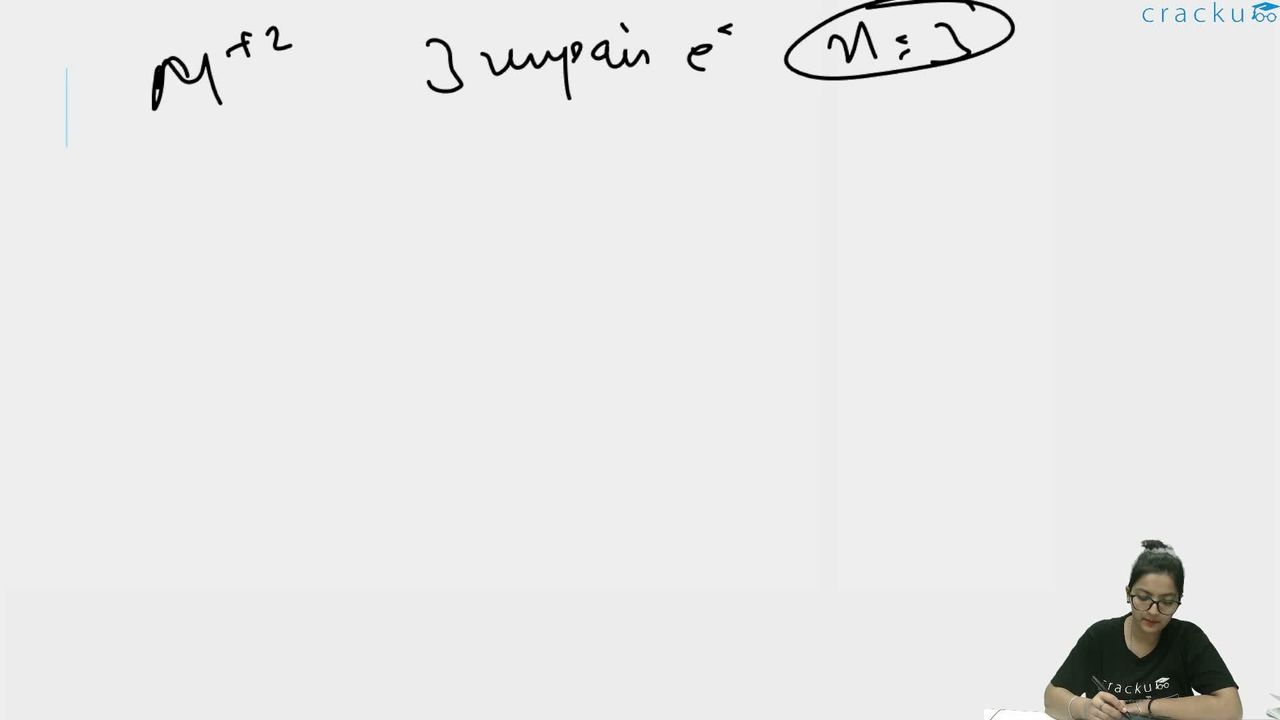
To determine the number of unpaired electrons, we use the spin-only magnetic moment formula: $$\mu = \sqrt{n(n+2)}$$ BM. Substituting $$\mu = 3.86$$ gives $$3.86 = \sqrt{n(n+2)}$$ and thus $$14.9 \approx n(n+2)$$. For $$n = 3$$, $$\sqrt{3 \times 5} = \sqrt{15} \approx 3.87$$ BM, which matches the observed value.
Next, we consider first row transition metals in the +2 oxidation state, which typically lose two 4s electrons, leaving only the 3d electrons. We look for a 3d configuration with three unpaired electrons:
V$$^{2+}$$ (Z=23): [Ar] 3d$$^3$$ - 3 unpaired electrons. Matches.
Cr$$^{2+}$$ (Z=24): [Ar] 3d$$^4$$ - 4 unpaired electrons (high spin). Does not match.
Mn$$^{2+}$$ (Z=25): [Ar] 3d$$^5$$ - 5 unpaired electrons. Does not match.
Fe$$^{2+}$$ (Z=26): [Ar] 3d$$^6$$ - 4 unpaired electrons (high spin). Does not match.
Co$$^{2+}$$ (Z=27): [Ar] 3d$$^7$$ - 3 unpaired electrons, but among the given options only Z=23 is listed.
The correct answer is Option 3: 23 (Vanadium).
Was this solution helpful?
Click on the Email ☝️ to Watch the Video Solution
Create a FREE account and get:
_1.webp)

Educational materials for JEE preparation

Ask our AI anything

AI can make mistakes. Please verify important information.
AI can make mistakes. Please verify important information.
