
Join Our JEE Preparation Group
Prep with like-minded aspirants; Get access to free daily tests and study material.
Sign in
Please select an account to continue using cracku.in
↓ →
Join Our JEE Preparation Group
Prep with like-minded aspirants; Get access to free daily tests and study material.
We begin by recalling the basic classification of smog. There are mainly two recognised types of smog in atmospheric chemistry:
$$\text{(i) Reducing smog}$$, also called classical or London smog, which is rich in $$SO_2$$ and soot and is favoured by low temperature and high humidity without requiring strong sunlight.
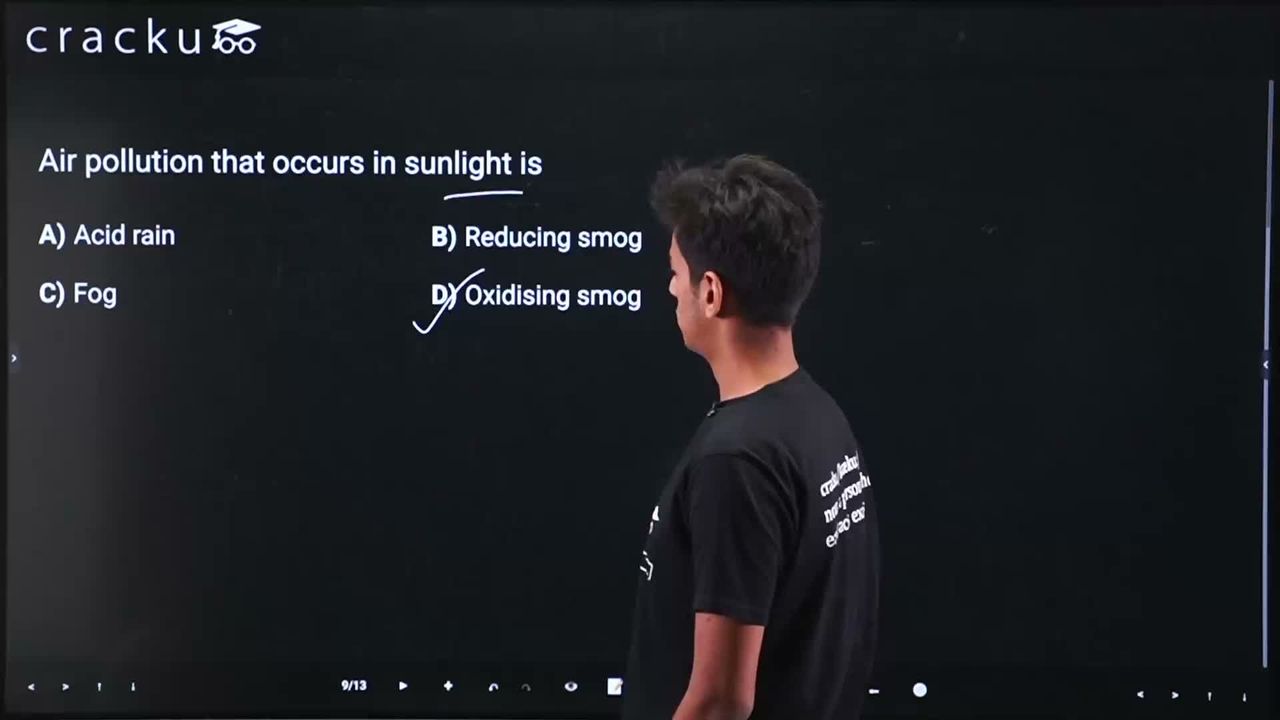
$$\text{(ii) Oxidising smog}$$, often termed photochemical smog, which develops when primary pollutants such as $$NO_x$$ (where $$x = 1,2$$) and volatile organic compounds are irradiated by intense sunlight. The ultraviolet component of sunlight breaks $$NO_2$$ as follows:
$$NO_2 \;\xrightarrow{\text{h}\nu}\; NO + O$$
The nascent oxygen atom produced in this photolysis step then combines with molecular oxygen already present in the air:
$$O + O_2 \longrightarrow O_3$$
The ozone $$O_3$$ so formed, along with peroxyacyl nitrates (PAN), aldehydes, and other oxidants, leads to a brownish haze that irritates eyes and damages vegetation. Because the overall mixture is rich in oxidising agents and its formation is triggered by sunlight, it is rightly called oxidising smog or photochemical smog.
By contrast, fog is simply a suspension of tiny water droplets, while acid rain refers to precipitation whose pH falls due to dissolved $$SO_2$$ and $$NO_x$$; neither of these phenomena specifically requires sunlight for its formation.
Thus, the variety of air pollution that characteristically occurs in strong sunlight is oxidising (photochemical) smog.
Hence, the correct answer is Option D.
Was this solution helpful?
Click on the Email ☝️ to Watch the Video Solution
Create a FREE account and get:
_1.webp)

Educational materials for JEE preparation

Ask our AI anything

AI can make mistakes. Please verify important information.
AI can make mistakes. Please verify important information.
