Sign in
Please select an account to continue using cracku.in
↓ →
Join Our JEE Preparation Group
Prep with like-minded aspirants; Get access to free daily tests and study material.
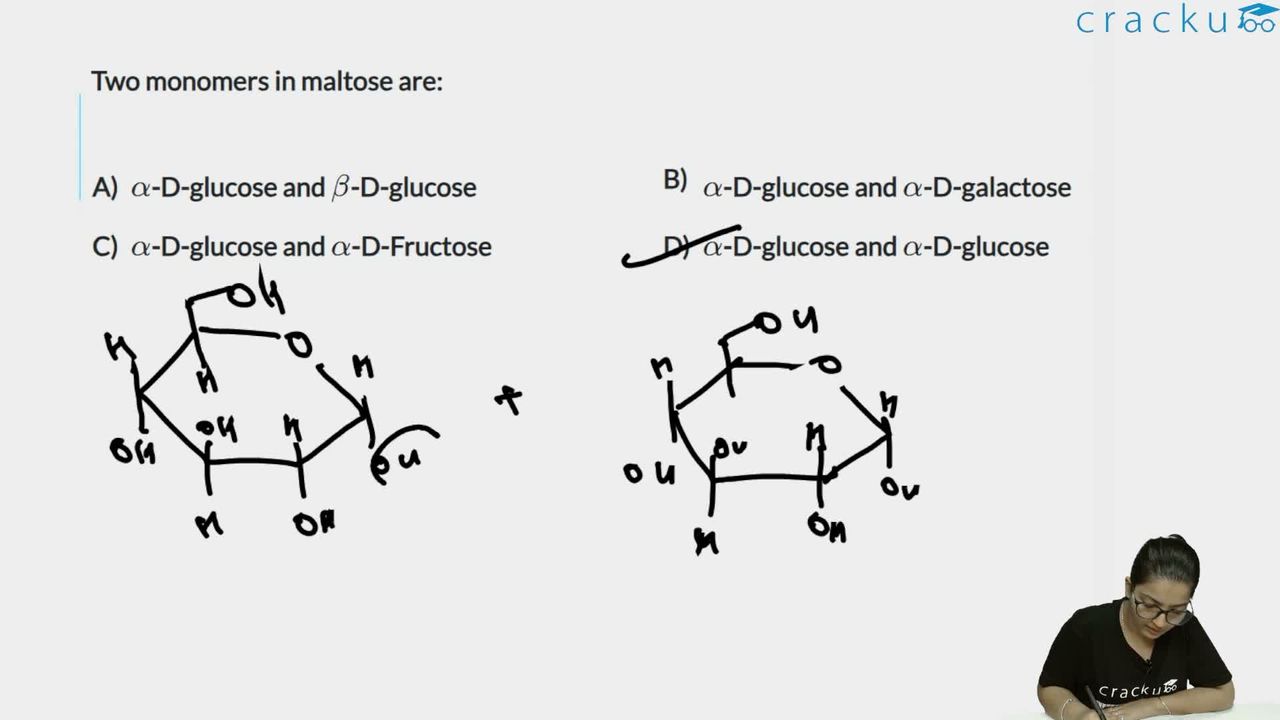
First, let us recall the definition of a disaccharide. A disaccharide is formed when two monosaccharide units join together through a glycosidic linkage with the elimination of one molecule of water. Maltose is one of the three most common disaccharides occurring in nature (the other two being sucrose and lactose).
We know from basic carbohydrate chemistry that the molecular formula of maltose is $$C_{12}H_{22}O_{11}$$. This formula is obtained by combining the molecular formulas of two hexose units ($$C_{6}H_{12}O_{6}$$ each) and then subtracting $$H_{2}O$$ to account for the condensation reaction:
$$C_{6}H_{12}O_{6} \;+\; C_{6}H_{12}O_{6} \;\;-\;\; H_{2}O \;=\; C_{12}H_{22}O_{11}.$$
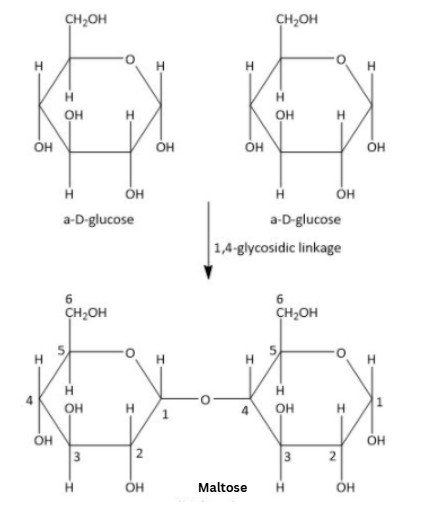
The next step is to identify exactly which hexose units are present. Hexoses commonly found in biological systems include $$\alpha$$-D-glucose, $$\beta$$-D-glucose, $$\alpha$$-D-galactose, and $$\alpha$$-D-fructose. The defining structural feature of maltose is its $$\alpha(1 \rightarrow 4)$$ glycosidic linkage. Such a linkage specifically involves the anomeric carbon (C-1) of one $$\alpha$$-D-glucose unit and the C-4 hydroxyl group of another $$\alpha$$-D-glucose unit.
Stating the structural fact explicitly: one $$\alpha$$-D-glucose donates its anomeric hydroxyl group at C-1 (in the $$\alpha$$-orientation), while the other $$\alpha$$-D-glucose supplies the hydroxyl group at C-4. During condensation, water ($$H_{2}O$$) is eliminated and an $$\alpha(1 \rightarrow 4)$$ bond is established. Because both monosaccharide units are the same—namely $$\alpha$$-D-glucose—the disaccharide is classified as a homodisaccharide.
We can summarize the composition symbolically as
$$\alpha\text{-D-glucose} \;+\; \alpha\text{-D-glucose} \;\xrightarrow[\text{condensation}]{\alpha(1 \rightarrow 4)\,\text{linkage}} \text{Maltose} \;+\; H_{2}O.$$
No other combination of monosaccharides matches both the molecular formula and the characteristic $$\alpha(1 \rightarrow 4)$$ linkage observed in maltose. Therefore, the only correct description among the given choices is the pair of two $$\alpha$$-D-glucose units.
Hence, the correct answer is Option D.
Create a FREE account and get:
Predict your JEE Main percentile, rank & performance in seconds
Educational materials for JEE preparation
Ask our AI anything
AI can make mistakes. Please verify important information.