
Join Our JEE Preparation Group
Prep with like-minded aspirants; Get access to free daily tests and study material.
Sign in
Please select an account to continue using cracku.in
↓ →
Join Our JEE Preparation Group
Prep with like-minded aspirants; Get access to free daily tests and study material.
The correct order of the calculated spin-only magnetic moments of complexes (A) to (D) is:
(A) Ni(CO)$$_4$$
(B) [Ni(H$$_2$$O)$$_6$$]Cl$$_2$$
(C) Na$$_2$$[Ni(CN)$$_4$$]
(D) PdCl$$_2$$(PPh$$_3$$)$$_2$$
For transition-metal complexes the spin-only magnetic moment is calculated from the formula
$$\mu_{\text{spin}}=\sqrt{n(n+2)}\;\text{BM},$$
where $$n$$ is the number of unpaired electrons and “BM’’ means Bohr magneton. Therefore we must first determine the oxidation state of the metal, write its $$d$$-electron configuration inside the ligand field actually adopted by the complex, count $$n$$, and only then compute $$\mu_{\text{spin}}$$. We do this one complex at a time.
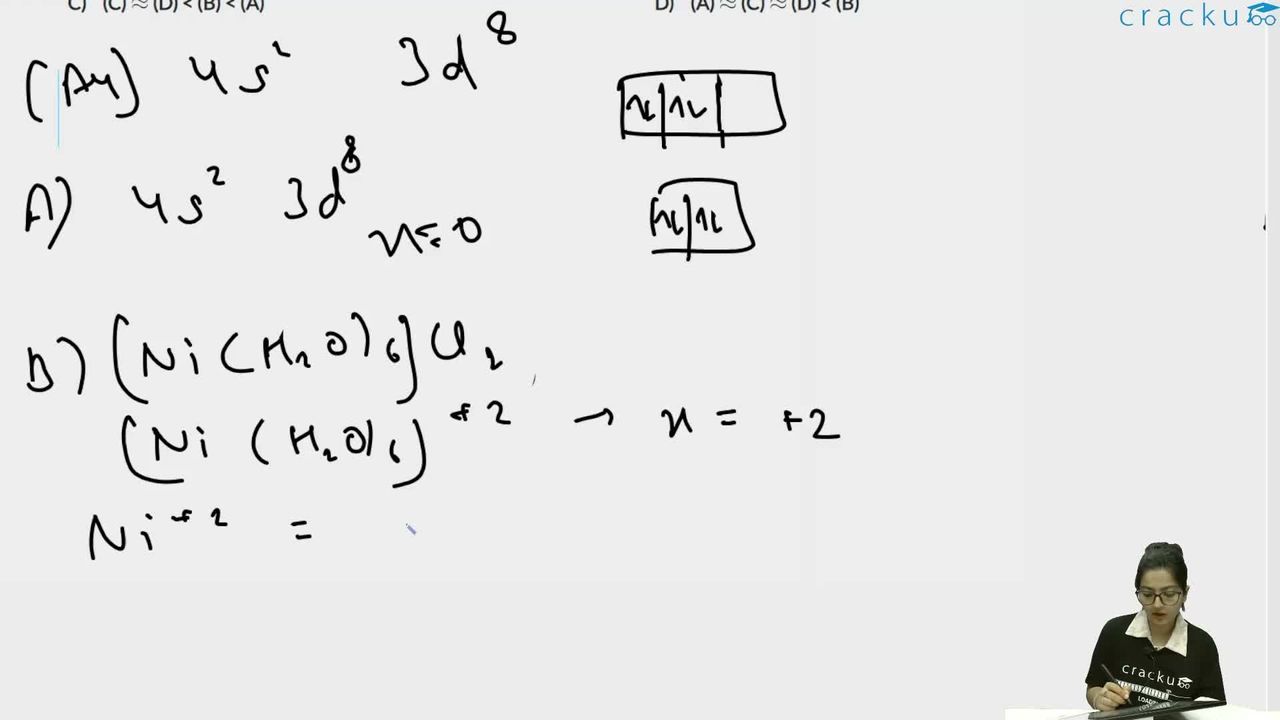
Complex (A) Ni(CO)$$_4$$
Each CO is a neutral ligand, so the oxidation state of Ni is $$0$$ and the free-atom configuration is
$$\text{Ni(0)}:[\text{Ar}]\,3d^{8}4s^{2}.$$
The 18-electron rule is satisfied if Ni uses all five $$3d$$ orbitals to hold ten electrons, leaving the empty $$4s$$ and three $$4p$$ orbitals to accept the eight electrons donated by the four CO ligands. Thus the metal attains a $$3d^{10}$$ configuration. All ten $$d$$ electrons are paired, so
$$n_{(A)}=0,\qquad \mu_{(A)}=0\;\text{BM}.$$
Complex (B) [Ni(H$$_2$$O)$$_6$$]Cl$$_2$$
The two chloride counter-ions show that the complex cation is $$\bigl[\text{Ni(H}_2\text{O)}_6\bigr]^{2+}$$, so the metal is in the $$+2$$ oxidation state. Hence
$$\text{Ni}^{2+}:[\text{Ar}]\,3d^{8}.$$
Water is a weak-field ligand; the octahedral crystal-field splitting $$\Delta_0$$ is smaller than the inter-electronic pairing energy $$P$$, so the complex is high-spin. For an octahedral field the five $$d$$ orbitals split into the lower-energy triply degenerate $$t_{2g}$$ set and the higher-energy doubly degenerate $$e_g$$ set. Filling eight electrons according to Hund’s rule gives
$$t_{2g}^{6}\,e_g^{2}.$$
All electrons in the $$t_{2g}$$ set are paired, but the two electrons occupying the two separate $$e_g$$ orbitals remain unpaired. Therefore
$$n_{(B)}=2$$
and, substituting into the spin-only formula,
$$\mu_{(B)}=\sqrt{2(2+2)}=\sqrt{8}\approx2.83\;\text{BM}.$$
Complex (C) Na$$_2$$[Ni(CN)$$_4$$]
With two Na$$^+$$ ions outside the square brackets, the anionic part is $$[\text{Ni(CN)}_4]^{2-}$$, so Ni is again $$+2$$ and hence $$d^8$$. Cyanide is a very strong-field ligand and forces a square-planar geometry for a $$d^{8}$$ metal. In a square-planar crystal field the $$d_{x^2-y^2}$$ orbital lies so high that all eight electrons pair in the four lower-energy orbitals, giving a completely paired $$d$$ shell. Consequently
$$n_{(C)}=0,\qquad \mu_{(C)}=0\;\text{BM}.$$
Complex (D) PdCl$$_2$$(PPh$$_3$$)$$_2$$
Triphenylphosphine (PPh$$_3$$) is neutral and each chloride is $$-1$$, so the oxidation state of palladium is $$+2$$ and the configuration is
$$\text{Pd}^{2+}:[\text{Kr}]\,4d^{8}.$$
Like Ni(II), a $$d^{8}$$ Pd(II) centre with strong-field ligands adopts a square-planar geometry (dsp$$^2$$ hybridisation). The energy order is analogous to that for complex (C); all eight $$d$$ electrons pair, giving
$$n_{(D)}=0,\qquad \mu_{(D)}=0\;\text{BM}.$$
Collecting the results:
$$ \mu_{(A)} = 0\;\text{BM},\quad \mu_{(C)} = 0\;\text{BM},\quad \mu_{(D)} = 0\;\text{BM},\quad \mu_{(B)} \approx 2.83\;\text{BM}. $$
Thus
$$(A)\approx(C)\approx(D)\;\lt \;(B).$$
Hence, the correct answer is Option D.
Was this solution helpful?
Click on the Email ☝️ to Watch the Video Solution
Create a FREE account and get:
_1.webp)

Educational materials for JEE preparation

Ask our AI anything

AI can make mistakes. Please verify important information.
AI can make mistakes. Please verify important information.


