
Join Our JEE Preparation Group
Prep with like-minded aspirants; Get access to free daily tests and study material.
Sign in
Please select an account to continue using cracku.in
↓ →
Join Our JEE Preparation Group
Prep with like-minded aspirants; Get access to free daily tests and study material.
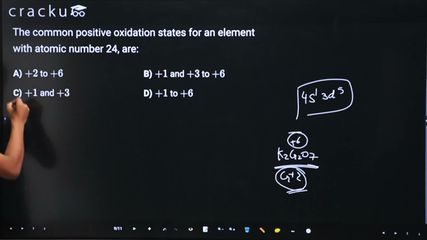
The common positive oxidation states for an element with atomic number 24, are:
The element with atomic number 24 is chromium (Cr), which has the electronic configuration $$[Ar]\, 3d^5\, 4s^1$$. This is a special half-filled configuration where one electron from the $$4s$$ orbital moves to the $$3d$$ orbital for extra stability.
Chromium commonly exhibits oxidation states of $$+2, +3, +4, +5,$$ and $$+6$$. The $$+2$$ state arises by losing the single $$4s$$ electron and one $$3d$$ electron, the $$+3$$ state (as in $$\text{Cr}^{3+}$$, which is very stable with a half-filled $$t_{2g}$$ level) by losing three electrons, and so on up to $$+6$$ where all six electrons (one $$4s$$ and five $$3d$$) are lost or shared, as in $$\text{CrO}_3$$ and $$\text{K}_2\text{Cr}_2\text{O}_7$$.
The $$+1$$ oxidation state is not common for chromium because removing just one electron does not lead to a particularly stable configuration, and Cr(I) compounds are extremely rare. Therefore, the common positive oxidation states of chromium range from $$+2$$ to $$+6$$.
The correct answer is Option A: $$+2$$ to $$+6$$.
Was this solution helpful?
Click on the Email ☝️ to Watch the Video Solution
Create a FREE account and get:
_1.webp)

Educational materials for JEE preparation

Ask our AI anything

AI can make mistakes. Please verify important information.
AI can make mistakes. Please verify important information.


