
Join Our JEE Preparation Group
Prep with like-minded aspirants; Get access to free daily tests and study material.
Sign in
Please select an account to continue using cracku.in
↓ →
Join Our JEE Preparation Group
Prep with like-minded aspirants; Get access to free daily tests and study material.
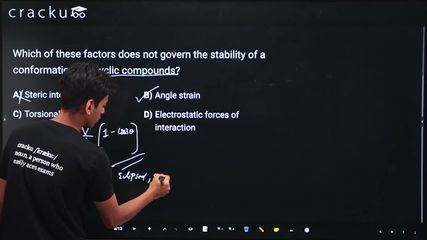
Which of these factors does not govern the stability of a conformation in acyclic compounds?
We begin by recalling that the different conformations of an acyclic (open-chain) molecule arise from rotation about single (σ) bonds. The relative stability of any two such conformers is decided by the types of strains or interactions that become more or less severe as the bond rotates.
Four commonly discussed factors are:
1. Steric interactions - also called van der Waals repulsions. When two bulky groups come too close, their electron clouds repel. Increased repulsion raises potential energy, so minimising steric crowding stabilises a conformation.
2. Torsional strain - extra energy due to eclipsing of bonds. It is quantified by the Fourier form $$E_{\text{torsion}} = \frac{V}{2}\bigl(1 - \cos 3\theta\bigr),$$ where $$\theta$$ is the dihedral angle. A staggered arrangement ($$\theta = 60^\circ,\,180^\circ$$) lowers this energy, whereas an eclipsed arrangement ($$\theta = 0^\circ$$) raises it. Thus torsional strain definitely governs conformational stability.
3. Electrostatic forces of interaction - favourable dipole-dipole alignments (antiparallel) or unfavourable ones (parallel) can make one conformer lower or higher in energy. Therefore these intermolecular-style intramolecular effects also contribute.
4. Angle strain - this is the strain that results when bond angles deviate from the ideal tetrahedral value $$109.5^\circ$$ for an $$sp^3$$ carbon. However, in an acyclic molecule the C-C-C bond angles are virtually free to assume their ideal values; simple rotation about a σ-bond does not force them to compress or expand. Angle strain is a concept that becomes important mainly in cyclic systems (small rings such as cyclopropane or cyclobutane) where the ring geometry locks the angles at non-ideal values.
So, among the four listed factors, steric interactions, torsional strain, and electrostatic interactions all influence how much potential energy a conformer possesses, whereas angle strain does not come into play for an open chain.
Hence, the correct answer is Option B.
Was this solution helpful?
Click on the Email ☝️ to Watch the Video Solution
Create a FREE account and get:
_1.webp)

Educational materials for JEE preparation

Ask our AI anything

AI can make mistakes. Please verify important information.
AI can make mistakes. Please verify important information.
