
Join Our JEE Preparation Group
Prep with like-minded aspirants; Get access to free daily tests and study material.
Sign in
Please select an account to continue using cracku.in
↓ →
Join Our JEE Preparation Group
Prep with like-minded aspirants; Get access to free daily tests and study material.
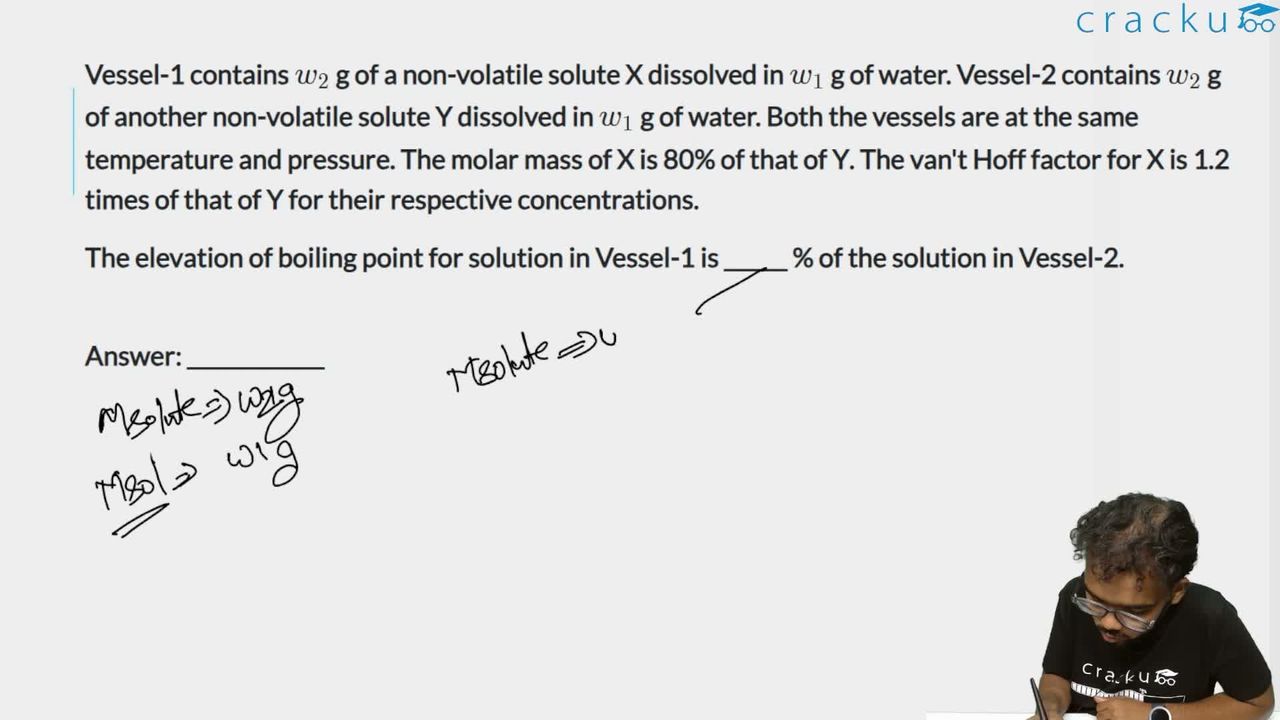
Vessel-1 contains $$w_2$$ g of a non-volatile solute X dissolved in $$w_1$$ g of water. Vessel-2 contains $$w_2$$ g of another non-volatile solute Y dissolved in $$w_1$$ g of water. Both the vessels are at the same temperature and pressure. The molar mass of X is 80% of that of Y. The van't Hoff factor for X is 1.2 times of that of Y for their respective concentrations.
The elevation of boiling point for solution in Vessel-1 is ______ % of the solution in Vessel-2.
Correct Answer: 150
The elevation of the boiling point for a dilute solution is given by the relation
$$\Delta T_b = i\,K_b\,m$$
where $$i$$ is the van’t Hoff factor, $$K_b$$ is the ebullioscopic constant of the solvent (same for both vessels because the solvent is water and the temperature is identical), and $$m$$ is the molality of the solute.
Because both vessels contain the same solvent (water) at the same temperature, $$K_b$$ is identical for the two solutions. Hence the ratio of the boiling-point elevations equals the product of the ratios of the van’t Hoff factors and the molalities:
$$\frac{\Delta T_{b1}}{\Delta T_{b2}} \;=\; \frac{i_X}{i_Y}\;\times\;\frac{m_X}{m_Y}$$
Step 1: Ratio of van’t Hoff factors
Given that the van’t Hoff factor for solute X is 1.2 times that for solute Y,
$$\frac{i_X}{i_Y} = 1.2$$
Step 2: Ratio of molalities
Molality is defined as $$m = \dfrac{\text{moles of solute}}{\text{kilograms of solvent}}$$.
With $$w_2$$ g of solute dissolved in $$w_1$$ g of water, the molality for any solute is
$$m = \frac{1000\,w_2}{M\,w_1}$$
where $$M$$ is the molar mass of the solute (in g mol$$^{-1}$$).
The two vessels have the same $$w_1$$ and $$w_2$$, so the ratio of their molalities depends only on their molar masses:
$$\frac{m_X}{m_Y} = \frac{M_Y}{M_X}$$
We are told that the molar mass of X is 80 % of that of Y:
$$M_X = 0.8\,M_Y \;\;\Longrightarrow\;\; \frac{M_Y}{M_X} = \frac{1}{0.8} = 1.25$$
Therefore,
$$\frac{m_X}{m_Y} = 1.25$$
Step 3: Ratio of boiling-point elevations
Combining the two ratios:
$$\frac{\Delta T_{b1}}{\Delta T_{b2}} = 1.2 \times 1.25 = 1.50$$
Thus, the elevation of the boiling point in Vessel 1 is 1.50 times (or 150 %) that in Vessel 2.
Answer: 150 %
Click on the Email ☝️ to Watch the Video Solution
Create a FREE account and get:
_1.webp)

Educational materials for JEE preparation

Ask our AI anything

AI can make mistakes. Please verify important information.
AI can make mistakes. Please verify important information.


