
Join Our JEE Preparation Group
Prep with like-minded aspirants; Get access to free daily tests and study material.
Sign in
Please select an account to continue using cracku.in
↓ →
Join Our JEE Preparation Group
Prep with like-minded aspirants; Get access to free daily tests and study material.
First, let us recall what we mean by a nitrogen-nitrogen bond. A nitrogen-nitrogen bond is a direct covalent linkage $$\text{N-N}$$ or $$\text{N}\equiv\text{N}$$ between two nitrogen atoms, with no other atom in between. If the two nitrogen atoms are connected only through some other atom (for example $$\text{N-O-N}$$), then there is no direct nitrogen-nitrogen bond.
Now we shall examine the molecular structures of each given oxide one by one.
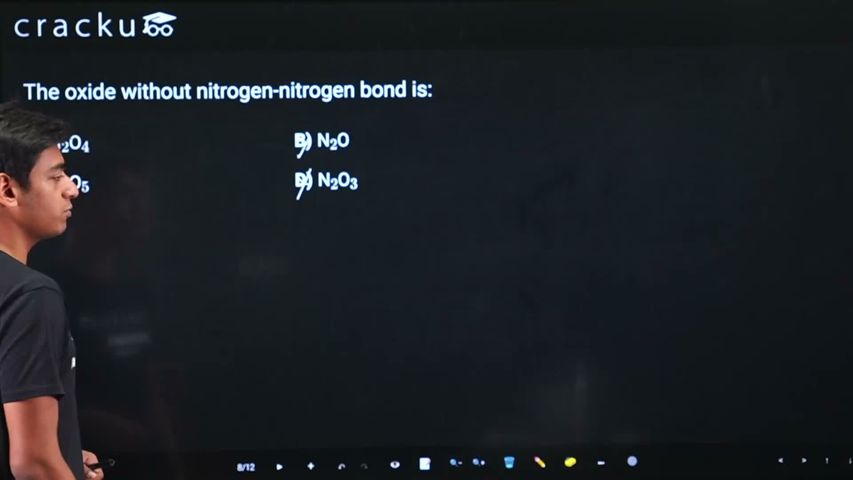
We have option A, $$\text{N}_2\text{O}_4$$. In the gas phase it exists as a dimer of nitrogen dioxide, and its accepted Lewis structure is $$\text{O}_2\text{N-N}\text{O}_2.$$ Here we can clearly see the direct single bond $$\text{N-N}$$ joining the two nitrogens. Hence $$\text{N}_2\text{O}_4$$ contains a nitrogen-nitrogen bond.
Next, option B, $$\text{N}_2\text{O}$$ (laughing gas). The commonly written resonance form is $$\text{N}\equiv\text{N}^+-\text{O}^-.$$ There is an unambiguous $$\text{N≡N}$$ triple bond between the two nitrogen atoms. Therefore $$\text{N}_2\text{O}$$ also possesses a nitrogen-nitrogen bond.
Moving to option C, $$\text{N}_2\text{O}_5$$. In the gaseous state its structure is best described as $$\text{O}_2\text{N-O-NO}_2.$$ Note the important point: the two nitrogen atoms are not directly bonded. They are connected through an oxygen bridge. The connectivity can be written as $$\text{N}\,-\,\text{O}\,-\,\text{N},$$ which clearly shows that an oxygen atom sits between the two nitrogens. Since no direct $$\text{N-N}$$ or $$\text{N≡N}$$ linkage exists, $$\text{N}_2\text{O}_5$$ lacks a nitrogen-nitrogen bond.
Finally, option D, $$\text{N}_2\text{O}_3$$. This molecule is the dimer of nitric oxide and is usually written as $$\text{O}_2\text{N-N}\text{O},$$ again displaying an explicit single bond $$\text{N-N}$$ between the two nitrogens. So $$\text{N}_2\text{O}_3$$ contains a nitrogen-nitrogen bond.
Summarising the observations:
• $$\text{N}_2\text{O}_4$$ → has $$\text{N-N}$$ bond.
• $$\text{N}_2\text{O}$$ → has $$\text{N≡N}$$ bond.
• $$\text{N}_2\text{O}_5$$ → no direct $$\text{N-N}$$ bond.
• $$\text{N}_2\text{O}_3$$ → has $$\text{N-N}$$ bond.
Hence, the only oxide in the list that does not contain a nitrogen-nitrogen bond is $$\text{N}_2\text{O}_5$$, which corresponds to Option C.
Hence, the correct answer is Option C.
Was this solution helpful?
Click on the Email ☝️ to Watch the Video Solution
Create a FREE account and get:
_1.webp)

Educational materials for JEE preparation

Ask our AI anything

AI can make mistakes. Please verify important information.
AI can make mistakes. Please verify important information.
