
Join Our JEE Preparation Group
Prep with like-minded aspirants; Get access to free daily tests and study material.
Sign in
Please select an account to continue using cracku.in
↓ →
Join Our JEE Preparation Group
Prep with like-minded aspirants; Get access to free daily tests and study material.
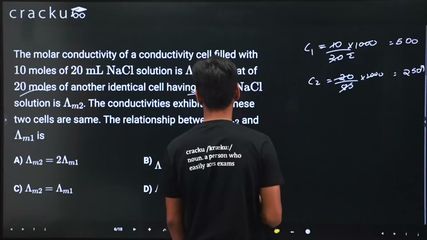
The molar conductivity of a conductivity cell filled with $$10$$ moles of $$20 \text{ mL NaCl}$$ solution is $$\Lambda_{m1}$$ and that of $$20$$ moles of another identical cell having $$80 \text{ mL NaCl}$$ solution is $$\Lambda_{m2}$$. The conductivities exhibited by these two cells are same. The relationship between $$\Lambda_{m2}$$ and $$\Lambda_{m1}$$ is
We have two identical conductivity cells filled with NaCl solutions: Cell 1 holds 10 moles in 20 mL and Cell 2 contains 20 moles in 80 mL, both showing the same conductivity.
Recalling that molar conductivity is given by
$$\Lambda_m = \frac{\kappa}{c}$$
where $$\kappa$$ is the conductivity and $$c$$ is the molar concentration (in mol/L).
For Cell 1, the concentration is
$$c_1 = \frac{10 \text{ mol}}{0.020 \text{ L}} = 500 \text{ mol/L}$$
In a similar way, for Cell 2 we find
$$c_2 = \frac{20 \text{ mol}}{0.080 \text{ L}} = 250 \text{ mol/L}$$
Since both cells exhibit the same conductivity, we write
$$\kappa_1 = \kappa_2 = \kappa$$
Hence, the molar conductivity of Cell 1 is
$$\Lambda_{m1} = \frac{\kappa}{c_1} = \frac{\kappa}{500}$$
and that of Cell 2 is
$$\Lambda_{m2} = \frac{\kappa}{c_2} = \frac{\kappa}{250}$$
Taking their ratio yields
$$\frac{\Lambda_{m2}}{\Lambda_{m1}} = \frac{\kappa/250}{\kappa/500} = \frac{500}{250} = 2$$
It follows that
$$\therefore \Lambda_{m2} = 2\Lambda_{m1}$$
The answer is Option A.
Was this solution helpful?
Click on the Email ☝️ to Watch the Video Solution
Create a FREE account and get:
_1.webp)

Educational materials for JEE preparation

Ask our AI anything

AI can make mistakes. Please verify important information.
AI can make mistakes. Please verify important information.
