
Join Our JEE Preparation Group
Prep with like-minded aspirants; Get access to free daily tests and study material.
Sign in
Please select an account to continue using cracku.in
↓ →
Join Our JEE Preparation Group
Prep with like-minded aspirants; Get access to free daily tests and study material.
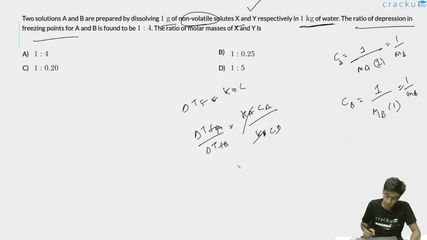
Two solutions A and B are prepared by dissolving $$1 \text{ g}$$ of non-volatile solutes X and Y respectively in $$1 \text{ kg}$$ of water. The ratio of depression in freezing points for A and B is found to be $$1:4$$. The ratio of molar masses of X and Y is
We are given two solutions A and B, each prepared by dissolving 1 g of non-volatile solutes X and Y respectively in 1 kg of water, and the ratio of depression in freezing points is 1 : 4.
Starting with the formula for freezing point depression, we have
$$\Delta T_f = K_f \times m$$
where $$m$$ denotes the molality of the solution.
Since 1 g of solute is dissolved in 1 kg of solvent, the molality can be expressed in terms of the molar mass $$M$$ as
$$m = \frac{1}{M \times 1} = \frac{1}{M}$$
Here, $$M$$ represents the molar mass of the solute (in g/mol).
When comparing the freezing point depressions of solutions A and B, we obtain
$$\frac{\Delta T_{f,A}}{\Delta T_{f,B}} = \frac{K_f / M_X}{K_f / M_Y} = \frac{M_Y}{M_X}$$
Given this ratio equals $$\frac{1}{4}$$, it follows that
$$\frac{M_Y}{M_X} = \frac{1}{4}$$
Hence,
$$\frac{M_X}{M_Y} = \frac{4}{1} = \frac{1}{0.25}$$
This establishes the molar mass ratio $$M_X : M_Y = 1 : 0.25$$, implying $$M_X = 4 \times M_Y$$.
Therefore, the correct choice is Option B.
Was this solution helpful?
Click on the Email ☝️ to Watch the Video Solution
Create a FREE account and get:
_1.webp)

Educational materials for JEE preparation

Ask our AI anything

AI can make mistakes. Please verify important information.
AI can make mistakes. Please verify important information.
