
Join Our JEE Preparation Group
Prep with like-minded aspirants; Get access to free daily tests and study material.
Sign in
Please select an account to continue using cracku.in
↓ →
Join Our JEE Preparation Group
Prep with like-minded aspirants; Get access to free daily tests and study material.
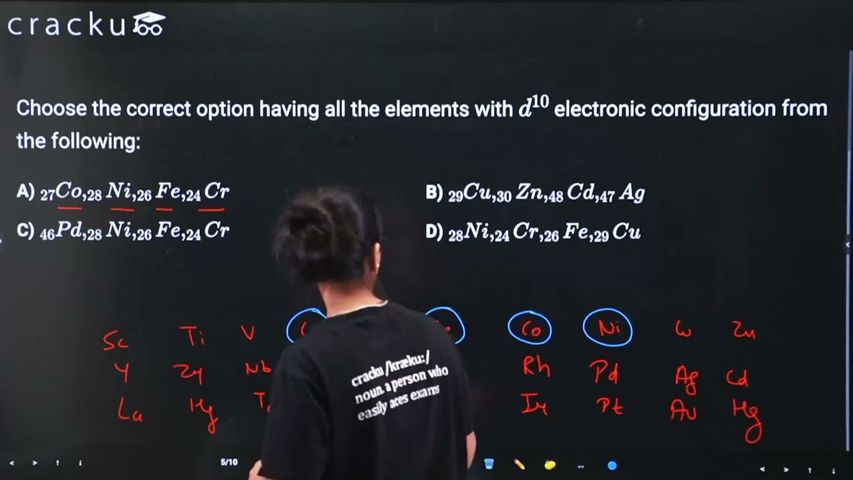
Choose the correct option having all the elements with $$d^{10}$$ electronic configuration from the following:
We need to find the option where all elements have a $$d^{10}$$ electronic configuration (in their ground state). First, recall that an element exhibits a $$d^{10}$$ configuration when its d-subshell is completely filled, which typically occurs near the end of a transition series because the fully filled d-subshell provides exceptional stability.
To identify such elements, we write the electronic configurations of the listed species and inspect their d-subshell. For $$_{24}Cr$$ the configuration is [Ar] 3d$$^5$$ 4s$$^1$$, which corresponds to $$d^5$$ rather than $$d^{10}$$. Similarly, $$_{26}Fe$$ is [Ar] 3d$$^6$$ 4s$$^2$$ (giving $$d^6$$), $$_{27}Co$$ is [Ar] 3d$$^7$$ 4s$$^2$$ (giving $$d^7$$), and $$_{28}Ni$$ is [Ar] 3d$$^8$$ 4s$$^2$$ (giving $$d^8$$). In contrast, $$_{29}Cu$$ has [Ar] 3d$$^{10}$$ 4s$$^1$$, $$_{30}Zn$$ has [Ar] 3d$$^{10}$$ 4s$$^2$$, $$_{46}Pd$$ has [Kr] 4d$$^{10}$$, $$_{47}Ag$$ has [Kr] 4d$$^{10}$$ 5s$$^1$$, and $$_{48}Cd$$ has [Kr] 4d$$^{10}$$ 5s$$^2$$, each of which possesses the fully filled d-subshell.
Next, we examine the given options to see which one consists exclusively of elements with a $$d^{10}$$ configuration. Option (1) contains Co, Ni, Fe, and Cr, none of which achieve $$d^{10}$$, so it is excluded. Option (2) lists Cu, Zn, Cd, and Ag, all of which have a complete $$d^{10}$$ subshell. Options (3) and (4) include only one such element each. The correct answer is Option (2): $$_{29}Cu$$, $$_{30}Zn$$, $$_{48}Cd$$, $$_{47}Ag$$.
Was this solution helpful?
Click on the Email ☝️ to Watch the Video Solution
Create a FREE account and get:
_1.webp)

Educational materials for JEE preparation

Ask our AI anything

AI can make mistakes. Please verify important information.
AI can make mistakes. Please verify important information.
