
Join Our JEE Preparation Group
Prep with like-minded aspirants; Get access to free daily tests and study material.
Sign in
Please select an account to continue using cracku.in
↓ →
Join Our JEE Preparation Group
Prep with like-minded aspirants; Get access to free daily tests and study material.
Among the statements (a) - (d), the incorrect ones are:
(a) Octahedral Co(III) complexes with strong field ligands have very high magnetic moments
(b) When $$\Delta_0 < P$$, the d-electron configuration of Co(III) in an octahedral complex is $$t_{eg}^4 e_g^2$$
(c) Wavelength of light absorbed by [Co(en)$$_3$$]$$^{3+}$$ is lower than that of [CoF$$_6$$]$$^{3-}$$
(d) If the $$\Delta_0$$ for an octahedral complex of Co(III) is 18,000 cm$$^{-1}$$, the $$\Delta_t$$ for its tetrahedral complex with the same ligand will be 16,000 cm$$^{-1}$$.
We first recall that Co(III) has the electronic configuration $$[Ar]\,3d^{6}$$ in the free-ion form. In an octahedral field the five d-orbitals split into the lower energy set $$t_{2g}$$ and the higher energy set $$e_g$$ with an energy gap denoted by $$\Delta_0$$. Whether the six d-electrons go into the upper $$e_g$$ level depends on the relative magnitudes of the crystal-field splitting energy $$\Delta_0$$ and the spin-pairing energy $$P$$.
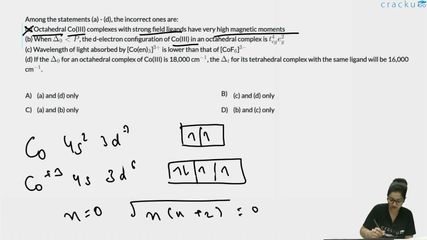
Statement (a) says: “Octahedral Co(III) complexes with strong-field ligands have very high magnetic moments.” A strong-field ligand means $$\Delta_0 > P$$. In that situation the lowest-energy way to place six electrons is to pair all of them in the lower level, giving the configuration
$$t_{2g}^6\,e_g^0.$$
This has $$n = 0$$ unpaired electrons. The formula for the spin-only magnetic moment is $$\mu = \sqrt{n(n+2)} \, \text{B.M.}$$. Substituting $$n = 0$$ we obtain $$\mu = 0$$. Thus such complexes are practically diamagnetic, certainly not “very high” in magnetic moment. Hence statement (a) is incorrect.
Statement (b) says: “When $$\Delta_0 < P$$, the d-electron configuration of Co(III) in an octahedral complex is $$t_{2g}^4 e_g^2$$.” For a weak-field ligand ($$\Delta_0 < P$$) the electrons prefer to avoid pairing and occupy the higher $$e_g$$ set, leading exactly to the high-spin arrangement
$$t_{2g}^4\,e_g^2.$$
This matches the statement, so (b) is correct.
Statement (c) compares the light absorbed by $$[Co(en)_3]^{3+}$$ and $$[CoF_6]^{3-}$$. The ligand ethylenediamine (en) is a stronger field ligand than fluoride. Therefore
$$\Delta_0(\text{en complex}) > \Delta_0(\text{F}^- \text{ complex}).$$
The energy of light absorbed in a d-d transition equals this splitting: $$E = h\nu = hc/\lambda = \Delta_0$$. Because energy and wavelength are inversely related, the larger $$\Delta_0$$ of the en complex corresponds to a smaller $$\lambda$$. Hence the wavelength absorbed by $$[Co(en)_3]^{3+}$$ is indeed lower than that absorbed by $$[CoF_6]^{3-}$$, making statement (c) correct.
Statement (d) concerns the relation between octahedral and tetrahedral splittings for the same ligand. The empirical relation is
$$\Delta_t \approx \dfrac{4}{9}\,\Delta_0 \qquad\text{or}\qquad \Delta_t \approx 0.44\,\Delta_0.$$
Substituting $$\Delta_0 = 18{,}000\;\text{cm}^{-1}$$, we get
$$\Delta_t = \dfrac{4}{9}\times18{,}000 = 8{,}000\;\text{cm}^{-1}\;( \text{approximately}).$$
The statement claims $$\Delta_t = 16{,}000\;\text{cm}^{-1}$$, which is almost twice the correct value, so statement (d) is incorrect.
Summarising, the incorrect statements are (a) and (d) only. These correspond to Option A.
Hence, the correct answer is Option A.
Was this solution helpful?
Click on the Email ☝️ to Watch the Video Solution
Create a FREE account and get:
_1.webp)

Educational materials for JEE preparation

Ask our AI anything

AI can make mistakes. Please verify important information.
AI can make mistakes. Please verify important information.
