Join WhatsApp Icon JEE WhatsApp Group
Question 41

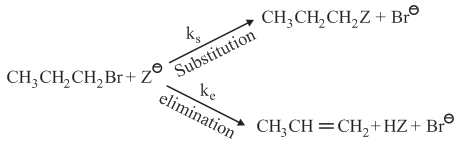
For the following reactions


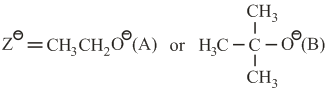
where:


k$$_s$$ and k$$_e$$ are respectively the rate constants for substitution and elimination, and $$\mu = \frac{k_s}{k_e}$$, the correct option is

We need to compare the relative rates of substitution ($$k_s$$) and elimination ($$k_e$$) for a primary alkyl halide reacting with two different alkoxide bases: Ethoxide ion (A) and tert-Butoxide ion (B).

Core Chemical Principles:

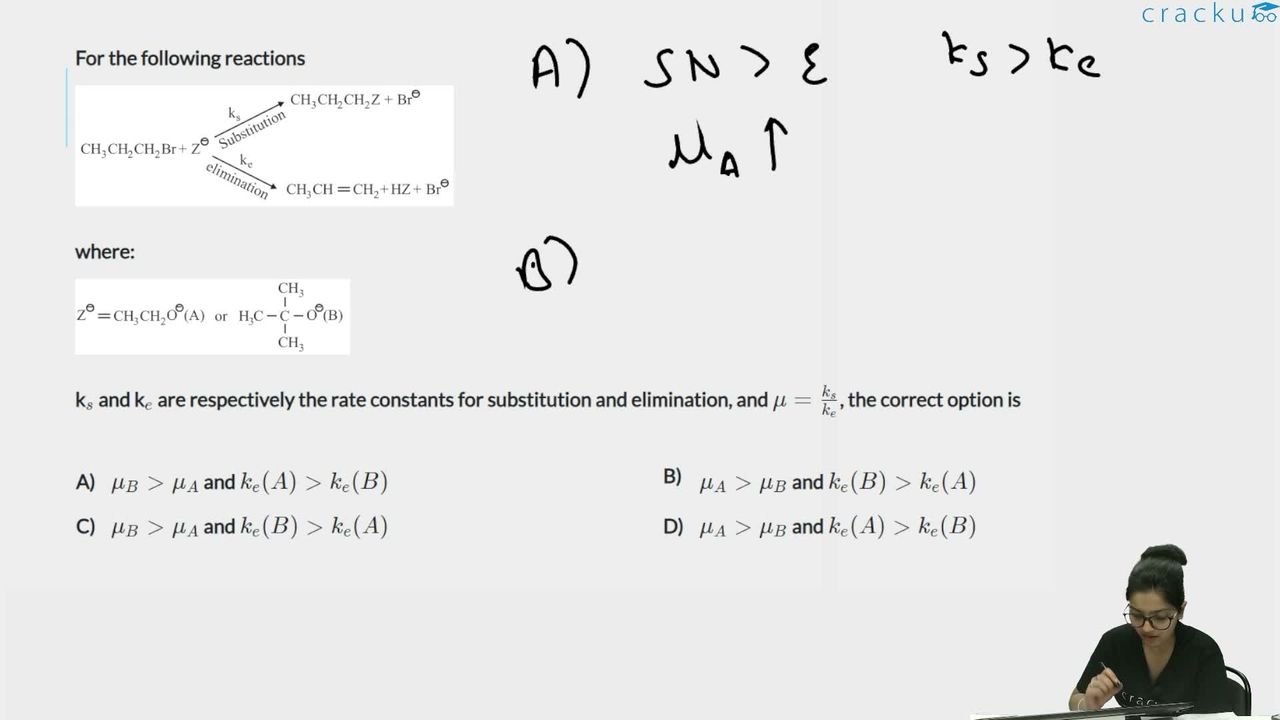
  • Ethoxide ion ($$\text{CH}_3\text{CH}_2\text{O}^\ominus$$ - A): A small, sterically unhindered nucleophile/base. It easily attacks the carbon center, making substitution ($$\text{S}_\text{N}2$$) the major pathway. Thus, $$k_s$$ is high and $$\mu_A = \frac{k_s}{k_e}$$ is large.
  • tert-Butoxide ion ($$(\text{CH}_3)_3\text{C--O}^\ominus$$ - B): A bulky, highly sterically hindered base. The steric crowding prevents it from attacking the carbon center for substitution, forcing it to abstract a peripheral proton to undergo elimination ($$\text{E}2$$). Thus, elimination is strongly favored, meaning $$k_e(B) > k_e(A)$$ and $$\mu_B = \frac{k_s}{k_e}$$ is very small.

Comparison Results:

  1. Since substitution is favored with the unhindered base A and elimination dominates with the bulky base B, we have: $$\mu_A > \mu_B$$
  2. Because tert-butoxide is a stronger, bulkier base designed specifically to drive elimination pathways, its elimination rate constant is significantly higher: $$k_e(B) > k_e(A)$$

Conclusion:

Steric hindrance in the tert-butoxide base suppresses substitution while accelerating elimination compared to the unhindered ethoxide base.

Answer: Option B — $$\mu_A > \mu_B$$ and $$k_e(B) > k_e(A)$$

Get AI Help

Video Solution

video

Create a FREE account and get:

  • Free JEE Mains Previous Papers PDF
  • Take JEE Mains paper tests

Free JEE Topicwise Questions

JEE Rotational MotionJEE Units & MeasurementsJEE Atomic StructureJEE GravitationJEE Periodic Table & PeriodicityJEE StatisticsJEE Inverse Trigonometric FunctionsJEE Magnetism & Magnetic MaterialsJEE Sequences & SeriesJEE MatricesJEE Alternating CurrentsJEE Carboxylic AcidsJEE Permutations & CombinationsJEE Work, Energy & PowerJEE Electromagnetic InductionJEE Electronic DevicesJEE d and f-Block ElementsJEE Chemical KineticsJEE Heat TransferJEE Three Dimensional GeometryJEE Magnetic Effects of CurrentJEE Hydrocarbons - AromaticJEE Electromagnetic WavesJEE Aldehydes & KetonesJEE Hydrocarbons - AlkanesJEE Applications of DerivativesJEE EquilibriumJEE Indefinite IntegrationJEE Chemical ThermodynamicsJEE ElectrochemistryJEE ProbabilityJEE BiomoleculesJEE Continuity & DifferentiabilityJEE Kinetic Theory of GasesJEE Vector AlgebraJEE Hydrocarbons - AlkynesJEE Differential EquationsJEE Current & ResistanceJEE Straight LinesJEE WavesJEE Redox ReactionsJEE Hydrocarbons - AlkenesJEE DeterminantsJEE SolutionsJEE Ray OpticsJEE Dual Nature of Matter & RadiationJEE Chemical Bonding & Molecular StructureJEE Complex NumbersJEE Sets, Relations & FunctionsJEE Electric Charges & FieldsJEE Laws of MotionJEE Fluid MechanicsJEE Basic Concepts in ChemistryJEE Trigonometric FunctionsJEE LimitsJEE Laws of ThermodynamicsJEE Kinematics - 2D MotionJEE p-Block Elements (Groups 13-18)JEE Simple Harmonic MotionJEE Electric Potential & CapacitanceJEE Coordination CompoundsJEE JEE 2D GeometryJEE CirclesJEE Definite IntegrationJEE EMF & Circuit AnalysisJEE Surface TensionJEE Atoms & NucleiJEE Laboratory Experiments - XIJEE Number SystemJEE Basic Principles of Organic ChemistryJEE Wave OpticsJEE Quadratic EquationsJEE Alcohols, Phenols & EthersJEE Organic Compounds with HalogensJEE DifferentiationJEE Conic SectionsJEE Nitrogen-Containing CompoundsJEE ElasticityJEE Practical Organic ChemistryJEE Kinematics - 1D MotionJEE Purification & CharacterisationJEE Binomial Theorem
Ask AI