
Join Our JEE Preparation Group
Prep with like-minded aspirants; Get access to free daily tests and study material.
Sign in
Please select an account to continue using cracku.in
↓ →
Join Our JEE Preparation Group
Prep with like-minded aspirants; Get access to free daily tests and study material.
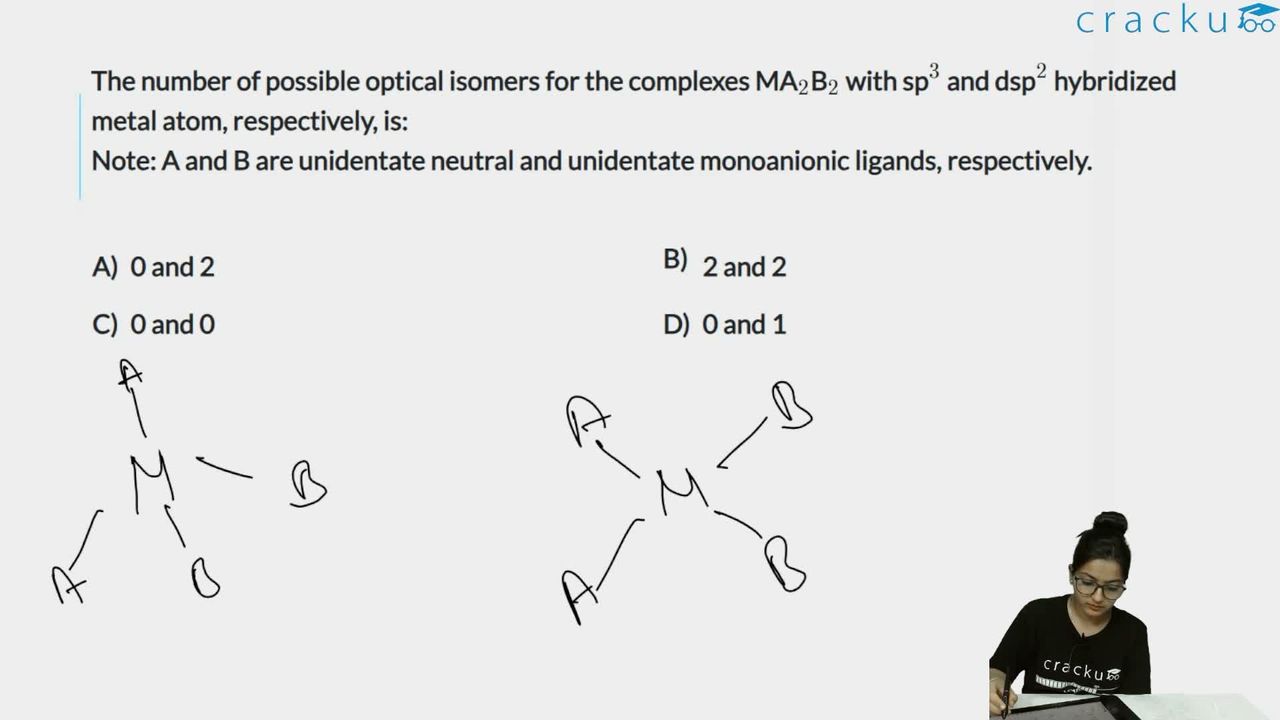
The number of possible optical isomers for the complexes MA$$_2$$B$$_2$$ with sp$$^3$$ and dsp$$^2$$ hybridized metal atom, respectively, is:
Note: A and B are unidentate neutral and unidentate monoanionic ligands, respectively.
First, we note the hybridisations mentioned:
$$$\text{sp}^3 \; \Longrightarrow \; \text{tetrahedral geometry}$$$ $$$\text{dsp}^2 \; \Longrightarrow \; \text{square-planar geometry}$$$
Optical isomerism (chirality) is possible only when the complex does not possess any element of symmetry such as a plane of symmetry ($$\sigma$$), a centre of symmetry ($$i$$) or an improper rotation axis ($$S_n$$). We now study the two geometries one by one for the formula $$\text{MA}_2\text{B}_2$$.
For the tetrahedral complex ($$\text{sp}^3$$):
The four corners of a tetrahedron are equivalent. If all four ligands were different ($$\text{MABCD}$$) the complex would indeed be chiral. However, in $$\text{MA}_2\text{B}_2$$ two ligands are identical ($$\text{A, A}$$) and the other two are also identical ($$\text{B, B}$$). We can always place the two $$\text{A}$$ ligands so that they lie opposite each other through a plane that also bisects the angle made by the two $$\text{B}$$ ligands. That plane is a mirror plane ($$\sigma$$) passing through the metal atom and bisecting the tetrahedron. Because of this mirror plane the structure is superposable on its mirror image. Hence it is achiral.
Therefore,
$$$\text{Number of optical isomers for the tetrahedral complex} = 0$$$
For the square-planar complex ($$\text{dsp}^2$$):
A square-planar complex lies entirely in one plane. That plane itself is a mirror plane ($$\sigma$$) for the molecule. Moreover, the complex also possesses a centre of symmetry ($$i$$) at the metal atom when two opposite positions are the same ligand (which must happen in $$\text{MA}_2\text{B}_2$$, giving either the cis or the trans arrangement). Because of either the mirror plane (cis form) or the centre of symmetry (trans form) the mirror image is always superposable on the original molecule.
Thus,
$$$\text{Number of optical isomers for the square-planar complex} = 0$$$
Collecting both results, we have
$$$\begin{aligned} \text{sp}^3\;(\text{tetrahedral}): & \; 0 \\ \text{dsp}^2\;(\text{square-planar}): & \; 0 \end{aligned}$$$
Hence, the correct answer is Option C.
Was this solution helpful?
Click on the Email ☝️ to Watch the Video Solution
Create a FREE account and get:
_1.webp)

Educational materials for JEE preparation

Ask our AI anything

AI can make mistakes. Please verify important information.
AI can make mistakes. Please verify important information.
