Join WhatsApp Icon JEE WhatsApp Group
Question 38

In the following reactions, products (A) and (B), respectively, are:
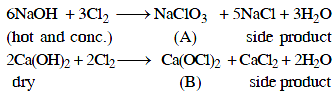
NaOH + Cl$$_2$$ $$\rightarrow$$ (A) + side products (hot and conc.)
Ca(OH)$$_2$$ + Cl$$_2$$ $$\rightarrow$$ (B) + side products (dry)
We begin with the behaviour of chlorine in alkaline medium. Chlorine is an element whose atoms are in oxidation state $$0$$. In alkaline solution it can simultaneously undergo reduction (to chloride, $$\text{Cl}^{-}$$, oxidation state $$-1$$) and oxidation (to higher oxy-anions such as hypochlorite $$\text{ClO}^{-}$$, oxidation state $$+1$$, or chlorate $$\text{ClO}_{3}^{-}$$, oxidation state $$+5$$). Such a simultaneous oxidation-reduction process is called disproportionation.

Whether hypochlorite or chlorate is formed depends on the temperature and concentration of the alkali:

• Cold, dilute alkali gives hypochlorite.

• Hot, concentrated alkali gives chlorate.

Now we treat each reaction one by one.

First reaction (hot and concentrated $$\text{NaOH}$$):

As stated above, hot and conc. alkali drives chlorine all the way to the chlorate ion. The balanced equation is obtained by equating the number of electrons lost and gained:

Reduction half-reaction (chlorine to chloride): $$\text{Cl}_{2} + 2e^{-} \rightarrow 2\text{Cl}^{-}$$

Oxidation half-reaction (chlorine to chlorate in basic medium): $$\text{Cl}_{2} + 6\text{OH}^{-} \rightarrow \text{ClO}_{3}^{-} + 5\text{Cl}^{-} + 3\text{H}_{2}\text{O} + 6e^{-}$$

Multiplying the reduction half by $$3$$ so that $$6e^{-}$$ are exchanged and then adding gives

$$6\text{Cl}^{-} + 3\text{Cl}_{2} + 6\text{OH}^{-} \rightarrow \text{ClO}_{3}^{-} + 5\text{Cl}^{-} + 3\text{H}_{2}\text{O}$$

Cancelling $$5\text{Cl}^{-}$$ from both sides we obtain

$$\text{Cl}^{-} + 3\text{Cl}_{2} + 6\text{OH}^{-} \rightarrow \text{ClO}_{3}^{-} + 3\text{H}_{2}\text{O}$$

Re-introducing sodium ions (because the base used is $$\text{NaOH}$$) and rewriting in molecular form gives

$$6\text{NaOH} + 3\text{Cl}_{2} \rightarrow 5\text{NaCl} + \text{NaClO}_{3} + 3\text{H}_{2}\text{O}$$

We see that the new chlorine-containing product other than common salt is $$\text{NaClO}_{3}$$, sodium chlorate. Therefore

$$(A) = \text{NaClO}_{3}$$.

Second reaction (dry $$\text{Ca(OH)}_{2}$$):

When absolutely dry chlorine is passed over absolutely dry slaked lime at ordinary temperature, chlorine again disproportionates, but now the medium is only mildly basic (solid state) and the product stops at the hypochlorite stage. A convenient experimentally observed stoichiometric equation is

$$2\text{Ca(OH)}_{2} + 2\text{Cl}_{2} \rightarrow \text{Ca(OCl)}_{2} + \text{CaCl}_{2} + 2\text{H}_{2}\text{O}$$

Here $$\text{Ca(OCl)}_{2}$$ is calcium hypochlorite. It is the active ingredient in modern commercial “bleaching powder”. Hence

$$(B) = \text{Ca(OCl)}_{2}$$.

Collecting the two results:

$$\begin{aligned} (A) &= \text{NaClO}_{3},\\ (B) &= \text{Ca(OCl)}_{2}. \end{aligned}$$

Among the given choices, Option A lists exactly these two compounds.

Hence, the correct answer is Option A.

Get AI Help

Create a FREE account and get:

  • Free JEE Mains Previous Papers PDF
  • Take JEE Mains paper tests

50,000+ JEE Students Trusted Our Score Calculator

Predict your JEE Main percentile, rank & performance in seconds

Ask AI

Ask our AI anything

AI can make mistakes. Please verify important information.
