
Join Our JEE Preparation Group
Prep with like-minded aspirants; Get access to free daily tests and study material.
Sign in
Please select an account to continue using cracku.in
↓ →
Join Our JEE Preparation Group
Prep with like-minded aspirants; Get access to free daily tests and study material.
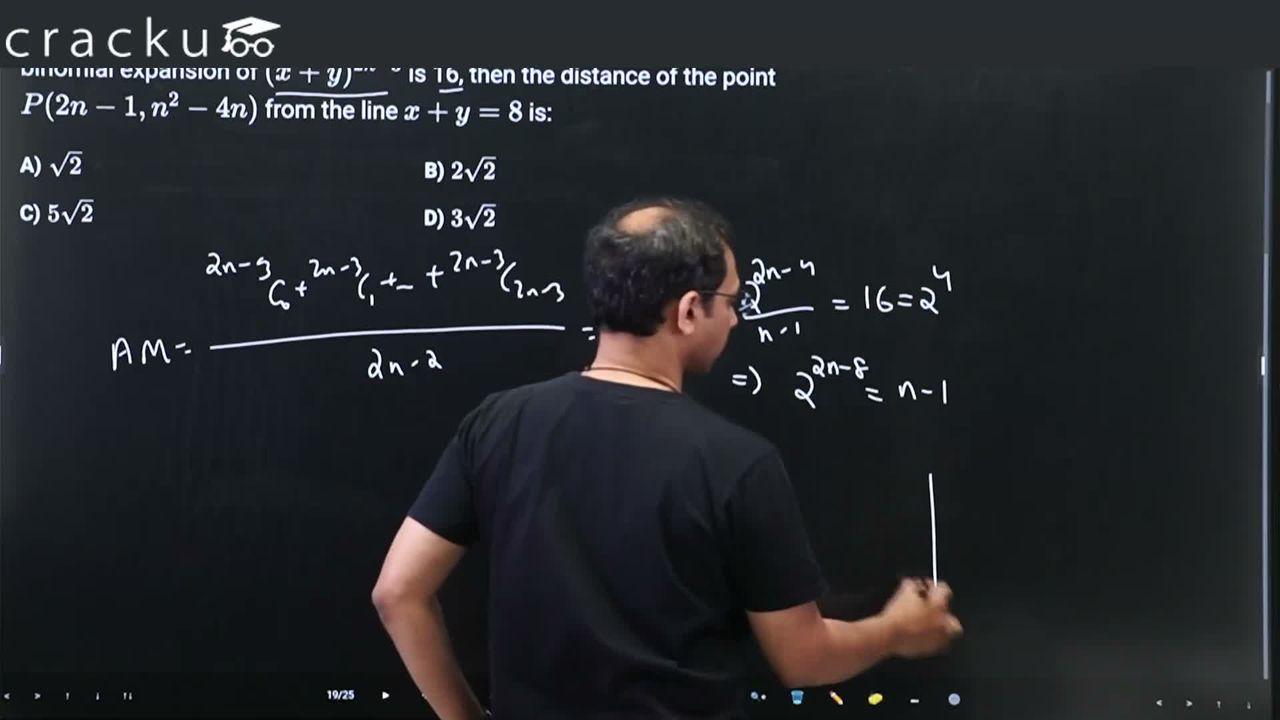
For an integer $$n \ge 2$$, if the arithmetic mean of all coefficients in the binomial expansion of $$(x + y)^{2n-3}$$ is 16, then the distance of the point $$P(2n - 1, n^2 - 4n)$$ from the line $$x + y = 8$$ is:
The binomial expansion $$(x + y)^{m}$$ contains $$(m + 1)$$ terms. The sum of all its coefficients is obtained by substituting $$x = 1,\, y = 1$$, giving $$2^{m}$$.
Hence, the arithmetic mean (A.M.) of the coefficients is $$\text{A.M.} \;=\; \frac{\text{sum of coefficients}}{\text{number of coefficients}} = \frac{2^{m}}{m + 1}$$.
In this problem, $$m = 2n - 3$$ and the given arithmetic mean equals $$16$$, so $$\frac{2^{\,2n - 3}}{(2n - 3) + 1} = 16.$$ Simplifying the denominator, $$2n - 3 + 1 = 2n - 2$$, we get $$\frac{2^{\,2n - 3}}{2n - 2} = 16.$$
Multiply both sides by $$2n - 2$$: $$2^{\,2n - 3} = 16\,(2n - 2).$$ Since $$16 = 2^{4}$$ and $$2n - 2 = 2(n - 1)$$, rewrite the right‐hand side: $$2^{\,2n - 3} = 2^{4}\,\bigl[\,2(n - 1)\bigr] = 2^{5}\,(n - 1).$$
Both sides are powers of $$2$$, so equate the exponents: $$2n - 3 = 5 + \log_{2}(n - 1).$$ This is possible only when $$n - 1$$ itself is a power of $$2$$, because the left side is an integer.
Write $$2^{\,2n - 3} = 2^{5}\,(n - 1) \;\Longrightarrow\; 2^{\,2n - 8} = n - 1.$$ Now test integer $$\,n \ge 2$$:
Case 1: $$n = 2 \;\Rightarrow\; 2^{\,2\cdot2 - 8} = 2^{-4} = \tfrac{1}{16} \neq 1.$$
Case 2: $$n = 3 \;\Rightarrow\; 2^{\,6 - 8} = 2^{-2} = \tfrac{1}{4} \neq 2.$$
Case 3: $$n = 4 \;\Rightarrow\; 2^{\,8 - 8} = 2^{0} = 1 \neq 3.$$
Case 4: $$n = 5 \;\Rightarrow\; 2^{\,10 - 8} = 2^{2} = 4 = 5 - 1.$$
Equality holds only for $$n = 5$$. No larger integer satisfies the equation because the left side then grows much faster than the right side. Thus, $$n = 5$$.
The coordinates of point $$P$$ are $$x_{P} = 2n - 1 = 2(5) - 1 = 9,$$ $$y_{P} = n^{2} - 4n = 5^{2} - 4\cdot5 = 25 - 20 = 5.$$ So $$P(9,\,5).$$
The line is $$x + y = 8$$, written in standard form as $$x + y - 8 = 0,$$ where $$a = 1,\, b = 1,\, c = -8.$$
Distance of $$P(x_{0},y_{0})$$ from $$ax + by + c = 0$$ is $$\text{Distance} = \frac{\lvert ax_{0} + by_{0} + c \rvert}{\sqrt{a^{2} + b^{2}}}.$$ Substitute $$x_{0} = 9,\, y_{0} = 5$$:
Numerator: $$\lvert 1\cdot9 + 1\cdot5 - 8 \rvert = \lvert 6 \rvert = 6.$$ Denominator: $$\sqrt{1^{2} + 1^{2}} = \sqrt{2}.$$
Therefore, $$\text{Distance} = \frac{6}{\sqrt{2}} = 3\sqrt{2}.$$
Hence the required distance is $$3\sqrt{2}$$, which corresponds to Option D.
Was this solution helpful?
Click on the Email ☝️ to Watch the Video Solution
Create a FREE account and get:
_1.webp)

Educational materials for JEE preparation

Ask our AI anything

AI can make mistakes. Please verify important information.
AI can make mistakes. Please verify important information.
