
Join Our JEE Preparation Group
Prep with like-minded aspirants; Get access to free daily tests and study material.
Sign in
Please select an account to continue using cracku.in
↓ →
Join Our JEE Preparation Group
Prep with like-minded aspirants; Get access to free daily tests and study material.
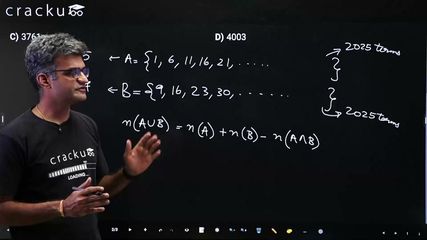
Let $$A = \{1, 6, 11, 16, \ldots\}$$ and $$B = \{9, 16, 23, 30, \ldots\}$$ be the sets consisting of the first 2025 terms of two arithmetic progressions. Then $$n(A \cup B)$$ is
The sequence $$A$$ is an arithmetic progression with first term $$1$$ and common difference $$5$$.
The sequence $$B$$ is an arithmetic progression with first term $$9$$ and common difference $$7$$.
Both sets contain exactly 2025 terms.
We must find the last term of the sequence that ends first to determine the upper boundary for their intersection.
The last term of set $$A$$ is:
$$L_A = 1 + (2025 - 1) \times 5 = 1 + 2024 \times 5 = 10121$$
The last term of set $$B$$ is:
$$L_B = 9 + (2025 - 1) \times 7 = 9 + 2024 \times 7 = 14177$$
The intersection of sets $$A$$ and $$B$$ contains common terms that form a new arithmetic progression.
The first common term is 16.
The common difference for this intersection sequence is the least common multiple of the original common differences, which is $$\text{LCM}(5, 7) = 35$$.
Let the number of common terms be $$m$$. The general term for the common sequence is $$16 + (m - 1) \times 35$$.
This term must be less than or equal to the smaller of the two final terms, which is 10121.
$$16 + (m - 1) \times 35 \le 10121$$
$$35(m - 1) \le 10105$$
$$m - 1 \le \frac{10105}{35}$$
$$m - 1 \le 288.71$$
Since $$m$$ must be an integer, the maximum value for $$m - 1$$ is 288.
$$m = 289$$
This means the number of common terms $$n(A \cap B)$$ is 289.
To find the union of the two sets, we apply the principle of inclusion and exclusion:
$$n(A \cup B) = n(A) + n(B) - n(A \cap B)$$
$$n(A \cup B) = 2025 + 2025 - 289$$
$$n(A \cup B) = 4050 - 289 = 3761$$
Hence the correct option is C.
Was this solution helpful?
Click on the Email ☝️ to Watch the Video Solution
Create a FREE account and get:
_1.webp)

Educational materials for JEE preparation

Ask our AI anything

AI can make mistakes. Please verify important information.
AI can make mistakes. Please verify important information.
