
Join Our JEE Preparation Group
Prep with like-minded aspirants; Get access to free daily tests and study material.
Sign in
Please select an account to continue using cracku.in
↓ →
Join Our JEE Preparation Group
Prep with like-minded aspirants; Get access to free daily tests and study material.
Two identical long current carrying wires are bent into the shapes shown in the following figures. If the magnitude of magnetic fields at the centres P and Q of a semicircular arc are B$$_1$$ and B$$_2$$ respectively, then the ratio $$\frac{B_1}{B_2}$$ is __________.
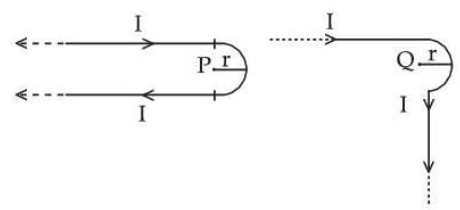
We need the magnetic fields at the centres P and Q of semicircular arcs in two different wire configurations.
The magnetic field at the centre of a semicircular arc of radius $$r$$ carrying current $$I$$ is:
$$B_{semi} = \frac{\mu_0 I}{4r}$$
The magnetic field due to a semi-infinite straight wire at a perpendicular distance $$d$$ from its end is:
$$B_{wire} = \frac{\mu_0 I}{4\pi d}$$
Also, an important fact: if the observation point lies on the line of the wire (i.e., on the wire's axis extended), the magnetic field from that wire at the point is zero (since $$d\vec{l} \times \hat{r} = 0$$).
Figure (I) -- Field at P:
The wire comes from infinity on the left along the top, goes to the right, makes a semicircular arc of radius $$r$$ (centre P, opening to the right), and returns to the left along the bottom to infinity.
The two straight portions are horizontal, each at a perpendicular distance $$r$$ from P. Neither wire's axis passes through P, so both contribute a non-zero field.
Using the right-hand rule, the semicircular arc (current going clockwise from top to bottom) and both semi-infinite wires all produce a field at P directed into the page.
$$B_1 = \frac{\mu_0 I}{4r} + \frac{\mu_0 I}{4\pi r} + \frac{\mu_0 I}{4\pi r}$$
$$= \frac{\mu_0 I}{4\pi r}(\pi + 1 + 1) = \frac{\mu_0 I}{4\pi r}(\pi + 2)$$
Figure (II) -- Field at Q:
The wire comes horizontally from the right, makes a semicircular arc of radius $$r$$ (centre Q, opening to the right), and then goes vertically downward to infinity.
The horizontal wire is at perpendicular distance $$r$$ from Q, so it contributes $$\frac{\mu_0 I}{4\pi r}$$ (into the page by right-hand rule).
The vertical wire starts from the bottom of the semicircle, which is directly below Q at distance $$r$$. When extended, this wire's axis passes through Q. Therefore, Q lies on the line of the wire, and the magnetic field at Q due to this wire is zero.
$$B_2 = \frac{\mu_0 I}{4r} + \frac{\mu_0 I}{4\pi r} + 0$$
$$= \frac{\mu_0 I}{4\pi r}(\pi + 1)$$
Now we take the ratio:
$$\frac{B_1}{B_2} = \frac{\frac{\mu_0 I}{4\pi r}(\pi + 2)}{\frac{\mu_0 I}{4\pi r}(\pi + 1)} = \frac{\pi + 2}{\pi + 1}$$
Hence, the correct answer is Option A.
Was this solution helpful?
Create a FREE account and get:
_1.webp)

Educational materials for JEE preparation

Ask our AI anything

AI can make mistakes. Please verify important information.
AI can make mistakes. Please verify important information.
