
Join Our JEE Preparation Group
Prep with like-minded aspirants; Get access to free daily tests and study material.
Sign in
Please select an account to continue using cracku.in
↓ →
Join Our JEE Preparation Group
Prep with like-minded aspirants; Get access to free daily tests and study material.
Consider the strong electrolytes Z$$_m$$X$$_n$$, U$$_m$$Y$$_p$$ and V$$_m$$X$$_n$$. Limiting molar conductivity ($$\Lambda^0$$) of U$$_m$$Y$$_p$$ and V$$_m$$X$$_n$$ are 250 and 440 S cm$$^2$$ mol$$^{-1}$$, respectively. The value of (m + n + p) is _______.
Given:
| Ion | Z$$^{n+}$$ | U$$^{p+}$$ | V$$^{n+}$$ | X$$^{m-}$$ | Y$$^{m-}$$ |
|---|---|---|---|---|---|
| $$\lambda^0$$ (S cm$$^2$$ mol$$^{-1}$$) | 50.0 | 25.0 | 100.0 | 80.0 | 100.0 |
$$\lambda^0$$ is the limiting molar conductivity of ions
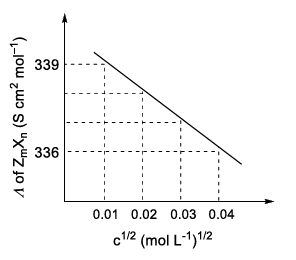
The plot of molar conductivity ($$\Lambda$$) of Z$$_m$$X$$_n$$ vs c$$^{1/2}$$ is given below.
Correct Answer: 7
For a strong electrolyte, Kohlrausch’s law of independent ionic migration states that its limiting molar conductivity is the sum of the ionic conductivities multiplied by their stoichiometric coefficients:
$$\Lambda^0=\sum \nu_i\,\lambda_i^0 \qquad -(1)$$
Let the stoichiometric coefficients in the three electrolytes be:
ZmXn ⟶ $$m\,\text{Z}^{n+}+n\,\text{X}^{m-}$$
UmYp ⟶ $$m\,\text{U}^{p+}+p\,\text{Y}^{m-}$$
VmXn ⟶ $$m\,\text{V}^{n+}+n\,\text{X}^{m-}$$
The given ionic conductivities are:
$$\lambda^0_{\text{Z}^{n+}}=50.0,\; \lambda^0_{\text{U}^{p+}}=25.0,\; \lambda^0_{\text{V}^{n+}}=100.0,\; \lambda^0_{\text{X}^{m-}}=80.0,\; \lambda^0_{\text{Y}^{m-}}=100.0\;\;(\text{all in S cm}^2\text{ mol}^{-1}).$$
Electrolyte UmYp
Applying (1):
$$\Lambda^0_{U_mY_p}=m\,\lambda^0_{\text{U}^{p+}}+p\,\lambda^0_{\text{Y}^{m-}}$$
$$250 = 25\,m + 100\,p$$
Divide by 25:
$$m + 4p = 10 \qquad -(2)$$
Electrolyte VmXn
Similarly:
$$\Lambda^0_{V_mX_n}=m\,\lambda^0_{\text{V}^{n+}}+n\,\lambda^0_{\text{X}^{m-}}$$
$$440 = 100\,m + 80\,n$$
Divide by 20:
$$5m + 4n = 22 \qquad -(3)$$
Equations (2) and (3) must be satisfied by positive integers m, n, p.
From (3):
$$5m = 22 - 4n$$
The right-hand side must be a multiple of 5. Testing integer values of $$n$$:
n = 1 → 22 − 4 = 18 (not multiple of 5)
n = 2 → 22 − 8 = 14 (not multiple of 5)
n = 3 → 22 − 12 = 10 (multiple of 5) ⇒ $$m = \frac{10}{5}=2$$
No larger positive value of $$n$$ keeps the right side positive, so the unique solution is
$$m = 2,\; n = 3$$
Substitute $$m = 2$$ into (2):
$$2 + 4p = 10 \;\;\Rightarrow\;\; 4p = 8 \;\;\Rightarrow\;\; p = 2$$
Thus
$$m = 2,\; n = 3,\; p = 2$$
The required sum is
$$(m+n+p) = 2 + 3 + 2 = 7$$
Hence, the value of (m + n + p) is 7.
Was this solution helpful?
Create a FREE account and get:
_1.webp)

Educational materials for JEE preparation

Ask our AI anything

AI can make mistakes. Please verify important information.
AI can make mistakes. Please verify important information.
