
Join Our JEE Preparation Group
Prep with like-minded aspirants; Get access to free daily tests and study material.
Sign in
Please select an account to continue using cracku.in
↓ →
Join Our JEE Preparation Group
Prep with like-minded aspirants; Get access to free daily tests and study material.
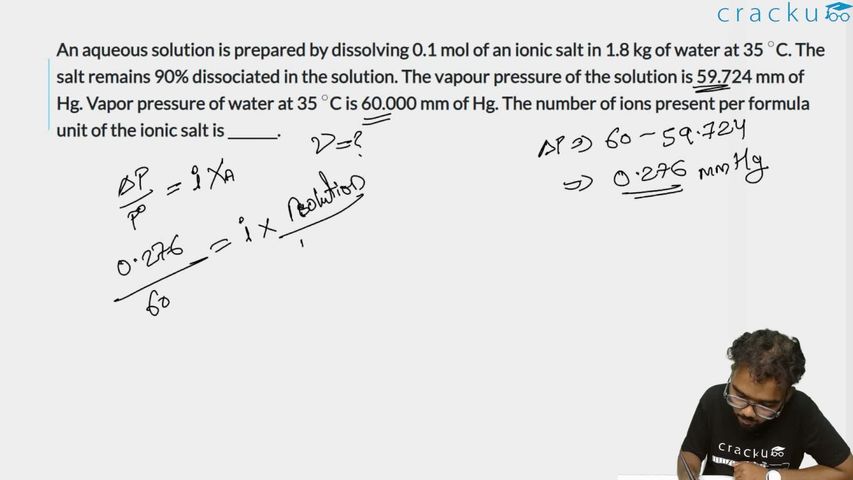
An aqueous solution is prepared by dissolving 0.1 mol of an ionic salt in 1.8 kg of water at 35 $$^\circ$$C. The salt remains 90% dissociated in the solution. The vapour pressure of the solution is 59.724 mm of Hg. Vapor pressure of water at 35 $$^\circ$$C is 60.000 mm of Hg. The number of ions present per formula unit of the ionic salt is _______.
Correct Answer: 5
The vapour-pressure lowering for an ideal dilute solution obeys Raoult’s law:
$$\frac{\Delta P}{P^{\circ}} = i\,X_{\text{solute}}$$
where $$\Delta P = P^{\circ}-P$$, $$P^{\circ}$$ is the vapour pressure of the pure solvent, $$P$$ is that of the solution, $$X_{\text{solute}}$$ is the mole-fraction of the solute and $$i$$ is the van’t Hoff factor.
Step 1: Calculate $$\Delta P$$ and the relative lowering
$$\Delta P = 60.000\;\text{mm Hg} - 59.724\;\text{mm Hg} = 0.276\;\text{mm Hg}$$
$$\frac{\Delta P}{P^{\circ}} = \frac{0.276}{60.000} = 4.60 \times 10^{-3}$$
Step 2: Mole fraction of the solute
Moles of solute (given) $$= 0.1\;\text{mol}$$
Mass of water $$= 1.8\;\text{kg} = 1800\;\text{g}$$
Moles of water $$= \frac{1800}{18} = 100\;\text{mol}$$
Total moles $$= 0.1 + 100 = 100.1$$
$$X_{\text{solute}} = \frac{0.1}{100.1} \approx 9.99 \times 10^{-4} \;(\text{≈}\, 1.00 \times 10^{-3})$$
Step 3: Determine the van’t Hoff factor $$i$$
$$i = \frac{\Delta P / P^{\circ}}{X_{\text{solute}}}
= \frac{4.60 \times 10^{-3}}{1.00 \times 10^{-3}}
= 4.6$$
Step 4: Relate $$i$$ to degree of dissociation
If one formula unit of the salt gives $$\nu$$ ions on complete dissociation, then for partial dissociation with degree $$\alpha$$:
$$i = 1 + (\nu - 1)\alpha \quad -(1)$$
The salt is 90 % dissociated, so $$\alpha = 0.90$$. Substituting $$i = 4.6$$ into equation $$(1)$$:
$$4.6 = 1 + (\nu - 1)(0.90)$$
$$4.6 - 1 = 0.90(\nu - 1)$$
$$3.6 = 0.90(\nu - 1)$$
$$\nu - 1 = \frac{3.6}{0.90} = 4$$
$$\nu = 5$$
Step 5: Final result
Each formula unit of the ionic salt produces 5 ions in solution.
Answer: 5
Was this solution helpful?
Click on the Email ☝️ to Watch the Video Solution
Create a FREE account and get:
_1.webp)

Educational materials for JEE preparation

Ask our AI anything

AI can make mistakes. Please verify important information.
AI can make mistakes. Please verify important information.
