
Join Our JEE Preparation Group
Prep with like-minded aspirants; Get access to free daily tests and study material.
Sign in
Please select an account to continue using cracku.in
↓ →
Join Our JEE Preparation Group
Prep with like-minded aspirants; Get access to free daily tests and study material.
O − O bond length in $$H_2O_2$$ is $$\underline{X}$$ than the O − O bond length in $$F_2O_2$$. The O − H bond length in $$H_2O_2$$ is $$\underline{Y}$$ than that of the O − F bond in $$F_2O_2$$. Choose the correct option for $$\underline{X}$$ and $$\underline{Y}$$ from the given below.
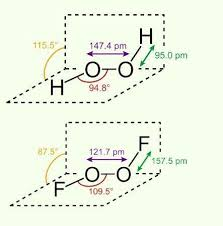
In $$H_{2}O_{2}$$, the O-O bond length is approximately $$1.48 \text{ Å}$$, while in $$F_{2}O_{2}$$, the O-O bond length is approximately $$1.22 \text{ Å}$$. So the O-O bond in $$H_{2}O_{2}$$ is longer than that in $$F_{2}O_{2}$$, giving $$X = \text{longer}$$.
The reason for this difference lies in electronegativity effects on lone-pair repulsion. In $$F_{2}O_{2}$$, fluorine is highly electronegative and draws electron density away from the oxygen atoms. This reduces the lone pair-lone pair repulsion between the two oxygen atoms, allowing the O-O bond to shorten significantly. In $$H_{2}O_{2}$$, hydrogen is less electronegative than oxygen, so the electron density remains concentrated on the oxygen atoms, leading to greater lone pair-lone pair repulsion and a longer O-O bond.
For the second comparison, the O-H bond length in $$H_{2}O_{2}$$ is about $$0.97 \text{ Å}$$, while the O-F bond length in $$F_{2}O_{2}$$ is about $$1.58 \text{ Å}$$. Thus the O-H bond in $$H_{2}O_{2}$$ is shorter than the O-F bond in $$F_{2}O_{2}$$, giving $$Y = \text{shorter}$$.
The O-F bond is longer primarily because fluorine has a much larger atomic radius ($$\approx 0.64 \text{ Å}$$) compared to hydrogen ($$\approx 0.31 \text{ Å}$$). The larger covalent radius of fluorine means the equilibrium bond distance in O-F is inherently greater than in O-H. Additionally, the O-H bond benefits from a better overlap between the small $$1s$$ orbital of hydrogen and the $$2p$$ orbital of oxygen, leading to a shorter, stronger bond.
Hence, the correct answer is Option D.
Was this solution helpful?
_1.webp)

Educational materials for JEE preparation

Ask our AI anything

AI can make mistakes. Please verify important information.
AI can make mistakes. Please verify important information.