For the following questions answer them individually
If the velocity of light $$c$$, universal gravitational constant $$G$$ and planck's constant $$h$$ are chosen as fundamental quantities. The dimensions of mass in the new system is:
For a train engine moving with speed of $$20 \text{ ms}^{-1}$$, the driver must apply brakes at a distance of 500 m before the station for the train to come to rest at the station. If the brakes were applied at half of this distance, the train engine would cross the station with speed $$\sqrt{x} \text{ ms}^{-1}$$. The value of $$x$$ is ______. (Assuming same retardation is produced by brakes)
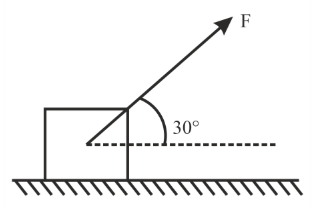
As shown in the figure a block of mass 10 kg lying on a horizontal surface is pulled by a force F acting at an angle $$30°$$, with horizontal. For $$\mu_s = 0.25$$, the block will just start to move for the value of $$F$$: [Given $$g = 10 \text{ m} \cdot \text{s}^{-2}$$]
A block is fastened to a horizontal spring. The block is pulled to a distance $$x = 10$$ cm from its equilibrium position (at $$x = 0$$) on a frictionless surface from rest. The energy of the block at $$x = 5$$ cm is 0.25 J. The spring constant of the spring is ______ $$\text{N m}^{-1}$$.
A force $$F = (5 + 3y^2)$$ acts on a particle in the $$y$$-direction, where $$F$$ is newton and $$y$$ is in meter. The work done by the force during a displacement from $$y = 2$$ m to $$y = 5$$ m is ______ J.
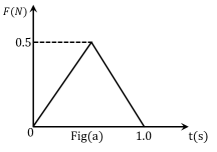
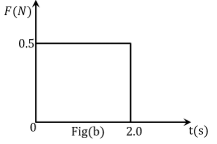
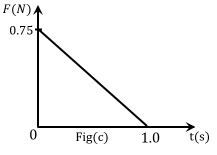
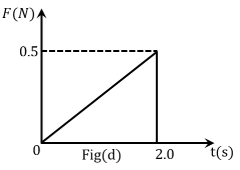
Figures (a), (b), (c) and (d) show variation of force with time


The impulse is highest in figure.
Moment of inertia of a disc of mass $$M$$ and radius '$$R$$' about any of its diameter is $$\frac{MR^2}{4}$$. The moment of inertia of this disc about an axis normal to the disc and passing through a point on its edge will be, $$\frac{x}{2}MR^2$$. The value of $$x$$ is ______.
The escape velocities of two planets $$A$$ and $$B$$ are in the ratio $$1 : 2$$. If the ratio of their radii respectively is $$1 : 3$$, then the ratio of acceleration due to gravity of planet $$A$$ to the acceleration of gravity of planet $$B$$ will be:
For a body projected at an angle with the horizontal from the ground, choose the correct statement
The Young's modulus of a steel wire of length 6 m and cross-sectional area $$3 \text{ mm}^2$$, is $$2 \times 10^{11} \text{ N/m}^2$$. The wire is suspended from its support on a given planet. A block of mass 4 kg is attached to the free end of the wire. The acceleration due to gravity on the planet is $$\frac{1}{4}$$ of its value on the earth. The elongation of wire is (Take $$g$$ on the earth $$= 10 \text{ m/s}^2$$):