
Join Our JEE Preparation Group
Prep with like-minded aspirants; Get access to free daily tests and study material.
Sign in
Please select an account to continue using cracku.in
↓ →
Join Our JEE Preparation Group
Prep with like-minded aspirants; Get access to free daily tests and study material.
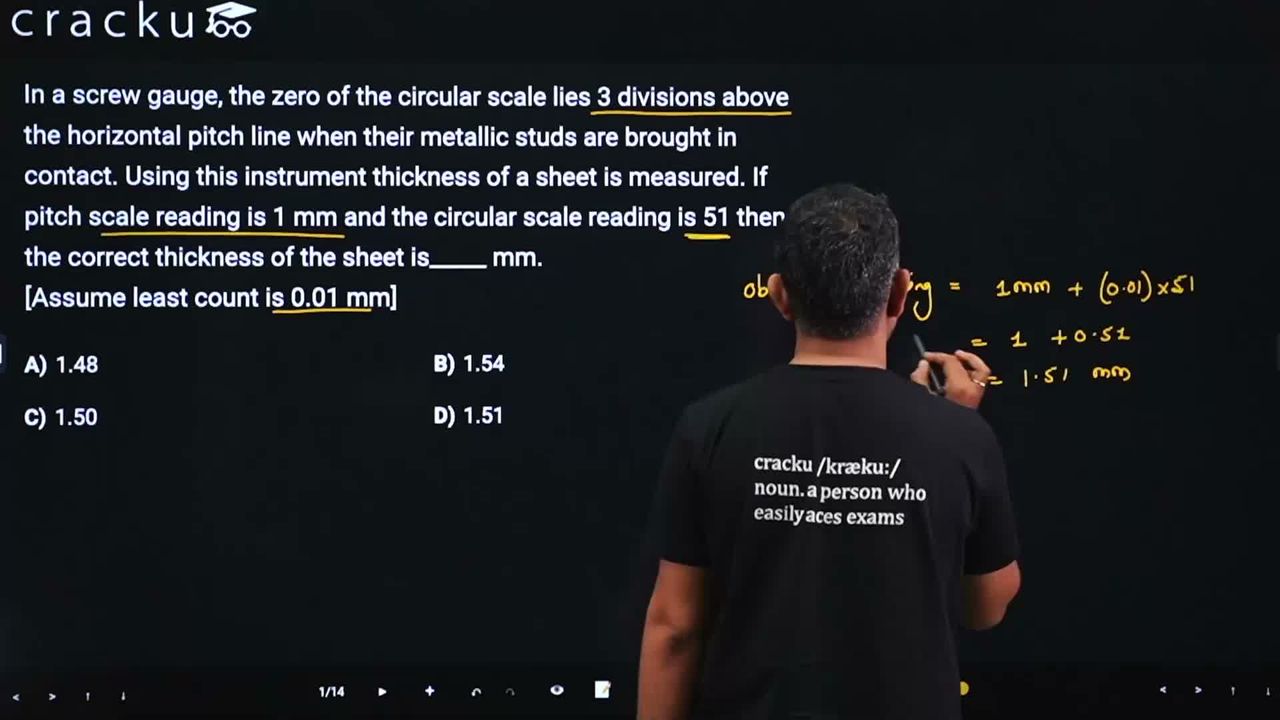
In a screw gauge, the zero of the circular scale lies 3 divisions above the horizontal pitch line when their metallic studs are brought in contact. Using this instrument thickness of a sheet is measured. If pitch scale reading is 1 mm and the circular scale reading is 51 then the correct thickness of the sheet is_____ mm.
[Assume least count is 0.01 mm]
We are given a screw gauge with a zero error where the zero of the circular scale lies 3 divisions above the horizontal pitch line when the studs are in contact. The least count (LC) is $$0.01$$ mm.
When the zero of the circular scale lies 3 divisions above the reference line, the circular scale has not reached its zero mark. This means extra rotation is needed to bring it to zero, which represents a negative zero error:
$$\text{Zero error} = -3 \times \text{LC} = -3 \times 0.01 = -0.03 \text{ mm}$$
The observed reading is given by:
$$\text{Observed reading} = \text{PSR} + (\text{CSR} \times \text{LC}) = 1 + (51 \times 0.01) = 1.51 \text{ mm}$$
The zero correction is the negative of the zero error, so the corrected reading is:
$$\text{Correct thickness} = \text{Observed reading} - \text{Zero error} = 1.51 - (-0.03) = 1.54 \text{ mm}$$
The correct answer is 1.54 mm.
Was this solution helpful?
Click on the Email ☝️ to Watch the Video Solution
Create a FREE account and get:
_1.webp)

Educational materials for JEE preparation

Ask our AI anything

AI can make mistakes. Please verify important information.
AI can make mistakes. Please verify important information.
