
Join Our JEE Preparation Group
Prep with like-minded aspirants; Get access to free daily tests and study material.
Sign in
Please select an account to continue using cracku.in
↓ →
Join Our JEE Preparation Group
Prep with like-minded aspirants; Get access to free daily tests and study material.
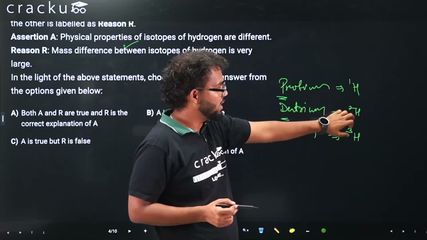
Given below are two statements: one is labelled as Assertion A and the other is labelled as Reason R.
Assertion A: Physical properties of isotopes of hydrogen are different.
Reason R: Mass difference between isotopes of hydrogen is very large.
In the light of the above statements, choose the correct answer from the options given below:
We need to evaluate both the Assertion and the Reason.
Assertion A: Physical properties of isotopes of hydrogen are different.
The three isotopes of hydrogen are:
Physical properties such as boiling point, melting point, and density differ among these isotopes. For example:
Assertion A is true.
Reason R: The mass difference between isotopes of hydrogen is very large.
The relative mass differences between hydrogen isotopes are the largest among all elements:
For comparison, carbon isotopes $$^{12}C$$ and $$^{13}C$$ have a mass ratio of only 13:12, which is a much smaller relative difference. The exceptionally large relative mass difference in hydrogen isotopes is unique among all elements. Reason R is true.
Explanation of the link: Physical properties depend on the mass of atoms/molecules. Since hydrogen isotopes have the largest relative mass differences, the differences in their physical properties (such as boiling point, melting point, bond energy, and density) are pronounced and measurable. The large mass difference is the direct cause of the significant variation in physical properties.
Therefore, both A and R are true, and R is the correct explanation of A.
The correct answer is Option A: Both A and R are true and R is the correct explanation of A.
Was this solution helpful?
Click on the Email ☝️ to Watch the Video Solution
Create a FREE account and get:
_1.webp)

Educational materials for JEE preparation

Ask our AI anything

AI can make mistakes. Please verify important information.
AI can make mistakes. Please verify important information.


