
Join Our JEE Preparation Group
Prep with like-minded aspirants; Get access to free daily tests and study material.
Sign in
Please select an account to continue using cracku.in
↓ →
Join Our JEE Preparation Group
Prep with like-minded aspirants; Get access to free daily tests and study material.
For the equilibrium $$2H_2O \rightleftharpoons H_3O^+ + OH^-$$; the value of $$\Delta G°$$ at 298 K is approximately:
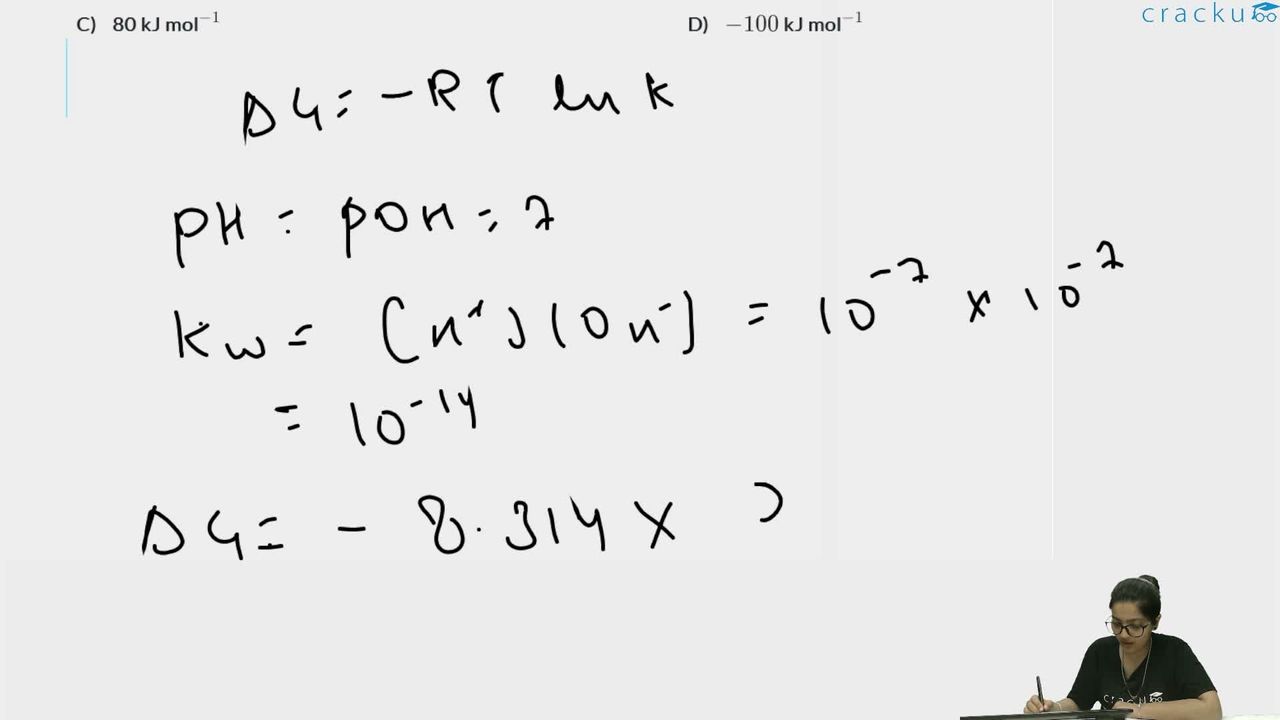
We are given the equilibrium reaction $$2H_2O \rightleftharpoons H_3O^+ + OH^-$$ at the standard temperature $$T = 298\ {\rm K}$$. For any reaction, the standard Gibbs free-energy change is related to the equilibrium constant by the well-known formula
$$\Delta G^\circ = -\,RT\,\ln K$$
where $$R = 8.314\ {\rm J\ mol^{-1}\ K^{-1}}$$ is the universal gas constant and $$K$$ is the thermodynamic equilibrium constant expressed in terms of activities.
In the present case the equilibrium constant is the ionic product of water. At $$25^\circ{\rm C}$$ (which is $$298\ {\rm K}$$) the measured value is
$$K = K_w = 10^{-14}$$
because the activities of pure liquid water on the left are each taken as unity, so the squared term $$a_{H_2O}^2 = 1$$, giving exactly the usual $$K_w$$ value. Now we substitute this $$K$$ into the formula.
$$\Delta G^\circ = -\,(8.314\ {\rm J\ mol^{-1}\ K^{-1}})\,(298\ {\rm K})\,\ln(10^{-14})$$
The natural logarithm of a power of ten can be rewritten explicitly:
$$\ln(10^{-14}) = -14\,\ln 10 = -14 \times 2.303 = -32.242$$
Putting this back, we get
$$\Delta G^\circ = -\,(8.314)(298)(-32.242)\ {\rm J\ mol^{-1}}$$
First multiply $$R$$ and $$T$$:
$$8.314 \times 298 = 2477.6\ {\rm J\ mol^{-1}}$$
Next multiply by the logarithmic factor:
$$2477.6 \times 32.242 \approx 79\,900\ {\rm J\ mol^{-1}}$$
Because we have a double negative, the overall sign is positive:
$$\Delta G^\circ \approx +\,79\,900\ {\rm J\ mol^{-1}}$$
Lastly, convert joules to kilojoules by dividing by 1000:
$$\Delta G^\circ \approx +\,79.9\ {\rm kJ\ mol^{-1}} \approx +\,80\ {\rm kJ\ mol^{-1}}$$
So, the standard Gibbs free-energy change for the dissociation of water is about $$+80\ {\rm kJ\ mol^{-1}}$$.
Hence, the correct answer is Option C.
Was this solution helpful?
Click on the Email ☝️ to Watch the Video Solution
Create a FREE account and get:
_1.webp)

Educational materials for JEE preparation

Ask our AI anything

AI can make mistakes. Please verify important information.
AI can make mistakes. Please verify important information.


