
Join Our JEE Preparation Group
Prep with like-minded aspirants; Get access to free daily tests and study material.
Sign in
Please select an account to continue using cracku.in
↓ →
Join Our JEE Preparation Group
Prep with like-minded aspirants; Get access to free daily tests and study material.
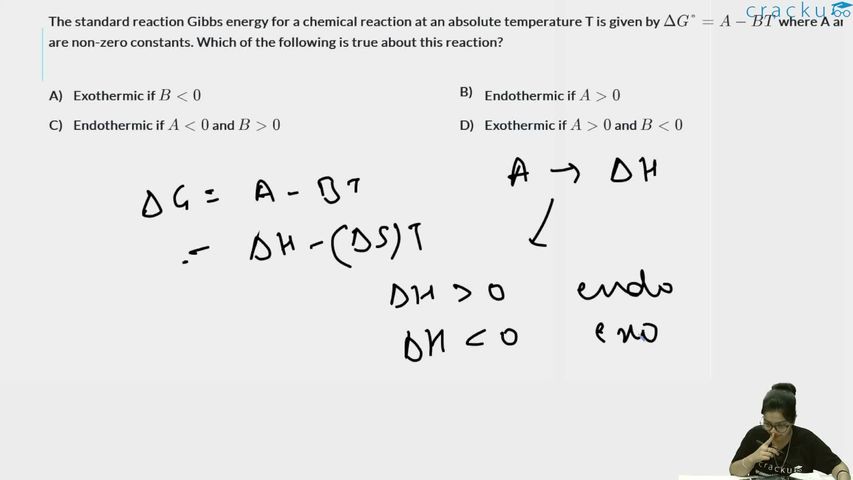
The standard reaction Gibbs energy for a chemical reaction at an absolute temperature T is given by $$\Delta G° = A - BT$$ where A and B are non-zero constants. Which of the following is true about this reaction?
We recall the fundamental thermodynamic relation that connects the standard Gibbs energy change, the standard enthalpy change and the standard entropy change of a reaction:
$$\Delta G^\circ \;=\; \Delta H^\circ \;-\; T\,\Delta S^\circ.$$
In the question the same quantity is expressed empirically as
$$\Delta G^\circ \;=\; A \;-\; B\,T,$$
where $$A$$ and $$B$$ are given to be non-zero constants. We now identify the two expressions term by term.
Comparing
$$\Delta G^\circ \;=\; \Delta H^\circ \;-\; T\,\Delta S^\circ$$
with
$$\Delta G^\circ \;=\; A \;-\; B\,T,$$
we equate the temperature-independent parts and the coefficients of the temperature term separately:
$$\Delta H^\circ \;=\; A,$$
$$-\,\Delta S^\circ \;=\; -\,B \;\;\Longrightarrow\;\; \Delta S^\circ \;=\; B.$$
Thus, the constant $$A$$ represents the standard enthalpy change $$\Delta H^\circ$$, while the constant $$B$$ represents the standard entropy change $$\Delta S^\circ$$.
Next, we recall the criterion for the heat character of a reaction:
• If $$\Delta H^\circ < 0,$$ the reaction is exothermic (heat is released).
• If $$\Delta H^\circ > 0,$$ the reaction is endothermic (heat is absorbed).
Since $$\Delta H^\circ = A,$$ the sign of $$A$$ alone decides whether the reaction is endothermic or exothermic. In particular,
$$A > 0 \;\;\Longrightarrow\;\; \Delta H^\circ > 0 \;\;\Longrightarrow\;\; \text{reaction is endothermic}.$$
Looking at the options, Option B states exactly this condition:
“Endothermic if $$A > 0$$.”
No other option relates the sign of $$A$$ (which equals $$\Delta H^\circ$$) correctly to the heat character of the process.
Hence, the correct answer is Option B.
Was this solution helpful?
Click on the Email ☝️ to Watch the Video Solution
Create a FREE account and get:
_1.webp)

Educational materials for JEE preparation

Ask our AI anything

AI can make mistakes. Please verify important information.
AI can make mistakes. Please verify important information.


