
Join Our JEE Preparation Group
Prep with like-minded aspirants; Get access to free daily tests and study material.
Sign in
Please select an account to continue using cracku.in
↓ →
Join Our JEE Preparation Group
Prep with like-minded aspirants; Get access to free daily tests and study material.
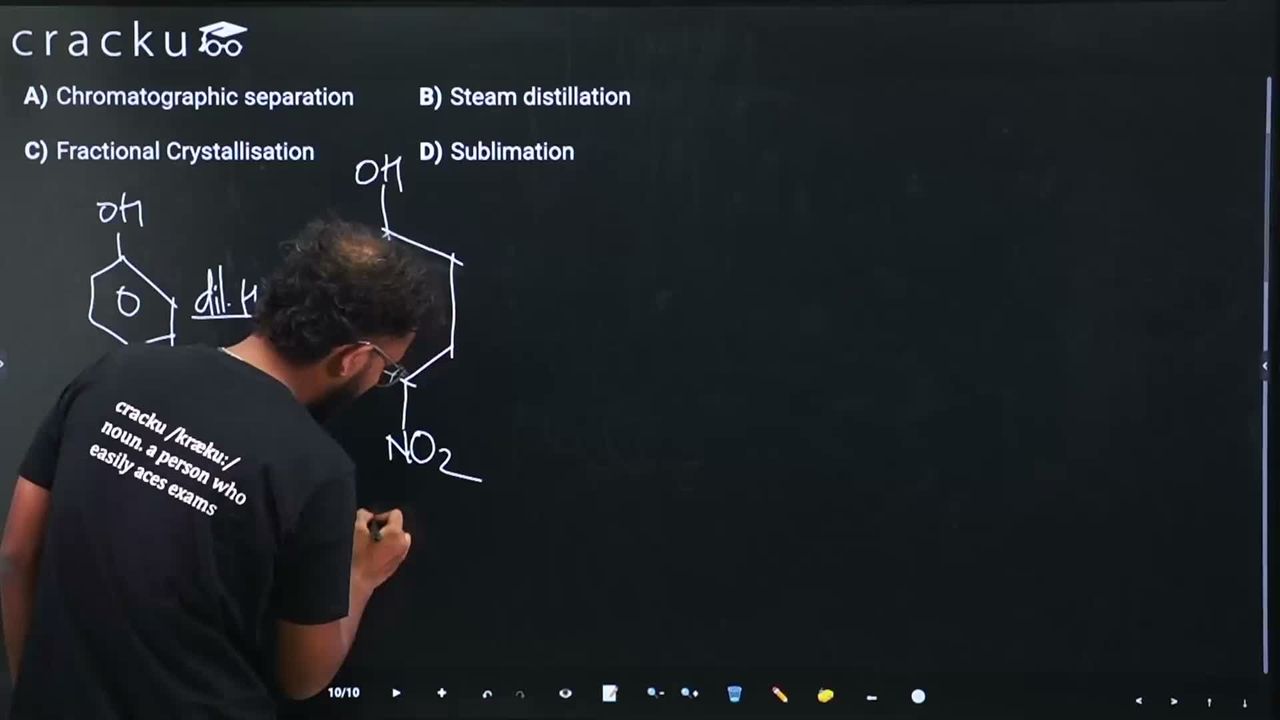
Phenol on reaction with dilute nitric acid, gives two products. Which method will be most efficient for large scale separation?
When phenol reacts with dilute nitric acid (dilute $$HNO_3$$), it undergoes electrophilic aromatic substitution to produce a mixture of:
1. ortho-nitrophenol (2-nitrophenol)
2. para-nitrophenol (4-nitrophenol)
Key difference between the two products:
ortho-Nitrophenol has intramolecular hydrogen bonding between the $$-OH$$ group and the adjacent $$-NO_2$$ group. This reduces its ability to form intermolecular hydrogen bonds with water, making it steam-volatile (lower boiling point, less soluble in water).
para-Nitrophenol has intermolecular hydrogen bonding (the $$-OH$$ and $$-NO_2$$ groups are far apart). This makes it non-volatile with steam (higher boiling point, more soluble in water).
Separation method:
Steam distillation is the most efficient method for large-scale separation. When steam is passed through the mixture, ortho-nitrophenol (being steam-volatile) distils over with the steam, while para-nitrophenol remains behind in the residue.
The correct answer is Option B: Steam distillation.
Was this solution helpful?
Click on the Email ☝️ to Watch the Video Solution
Create a FREE account and get:
_1.webp)

Educational materials for JEE preparation

Ask our AI anything

AI can make mistakes. Please verify important information.
AI can make mistakes. Please verify important information.
