
Join Our JEE Preparation Group
Prep with like-minded aspirants; Get access to free daily tests and study material.
Sign in
Please select an account to continue using cracku.in
↓ →
Join Our JEE Preparation Group
Prep with like-minded aspirants; Get access to free daily tests and study material.
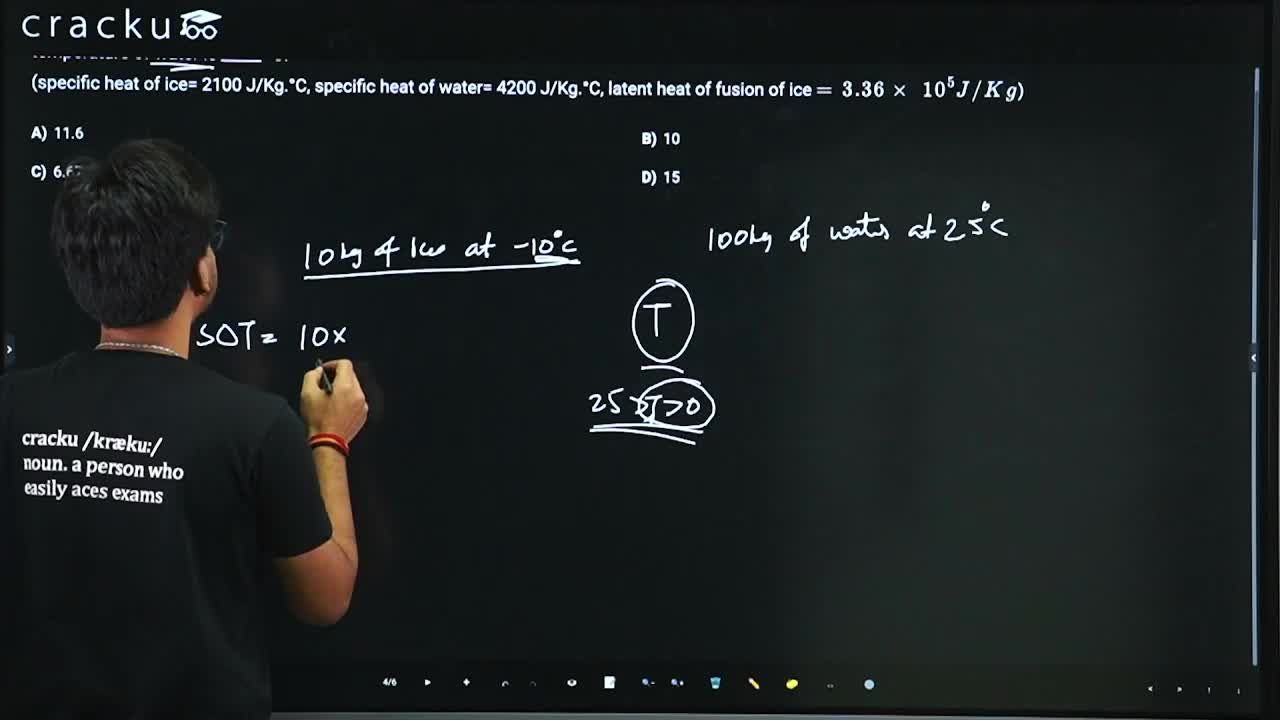
10 kg of ice at -10°C is added to 100 kg of water to lower its temperature from 25°C. Consider no heat exchange to surroundings. The decrement to the temperature of water is _____ °C.
(specific heat of ice= 2100 J/Kg.°C, specific heat of water= 4200 J/Kg.°C, latent heat of fusion of ice $$=3.36\times\ 10^5J/Kg$$)
We have 10 kg of ice at -10 °C and 100 kg of water at 25 °C.
The specific heats are $$c_{ice} = 2100$$ J/kg°C and $$c_{water} = 4200$$ J/kg°C, with latent heat of fusion $$L_f = 3.36 \times 10^5$$ J/kg.
First, warming the ice to 0 °C requires $$Q_1 = 10 \times 2100 \times 10 = 210000$$ J, and melting it requires $$Q_2 = 10 \times 336000 = 3360000$$ J, giving a total heat requirement of $$3570000$$ J.
The heat available from cooling 100 kg of water from 25 °C to 0 °C is $$10500000$$ J, which exceeds $$Q_1 + Q_2$$, so all the ice melts.
Let the final temperature of the mixture be $$T$$. Then heat lost by water cooling from 25 °C to $$T$$ equals heat gained by the ice warming and melting, giving
$$100 \times 4200 \times (25-T) = 210000 + 3360000 + 10 \times 4200 \times T.$$
Rearranging gives
$$10500000 - 420000T = 3570000 + 42000T,$$
so
$$6930000 = 462000T$$
and hence
$$T = 15°C.$$
Thus the temperature decrease is $$25 - 15 = 10$$°C. The correct answer is Option 2: 10°C.
Was this solution helpful?
Click on the Email ☝️ to Watch the Video Solution
Create a FREE account and get:
_1.webp)

Educational materials for JEE preparation

Ask our AI anything

AI can make mistakes. Please verify important information.
AI can make mistakes. Please verify important information.
