Join Our JEE Preparation Group
Prep with like-minded aspirants; Get access to free daily tests and study material.
Sign in
Please select an account to continue using cracku.in
↓ →
Join Our JEE Preparation Group
Prep with like-minded aspirants; Get access to free daily tests and study material.
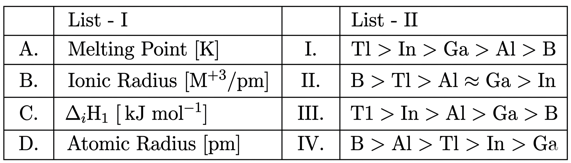
The melting point trend in Group 13 is highly irregular.
Unlike atomic radii, the ionic radii of M+3 ions follow a regular trend. As you move down the group, more shells are added, and the effective nuclear charge felt by the outermost electrons (in an ionic state) allows for a consistent increase in size.
The First Ionization Enthalpy is irregular due to poor shielding by d and f electrons.
Normally, atomic radius increases down a group. However, there is a anomaly between Aluminium and Gallium.
Was this solution helpful?
Create a FREE account and get:
_1.webp)

Educational materials for JEE preparation

Ask our AI anything

AI can make mistakes. Please verify important information.
AI can make mistakes. Please verify important information.