
Join Our JEE Preparation Group
Prep with like-minded aspirants; Get access to free daily tests and study material.
Sign in
Please select an account to continue using cracku.in
↓ →
Join Our JEE Preparation Group
Prep with like-minded aspirants; Get access to free daily tests and study material.
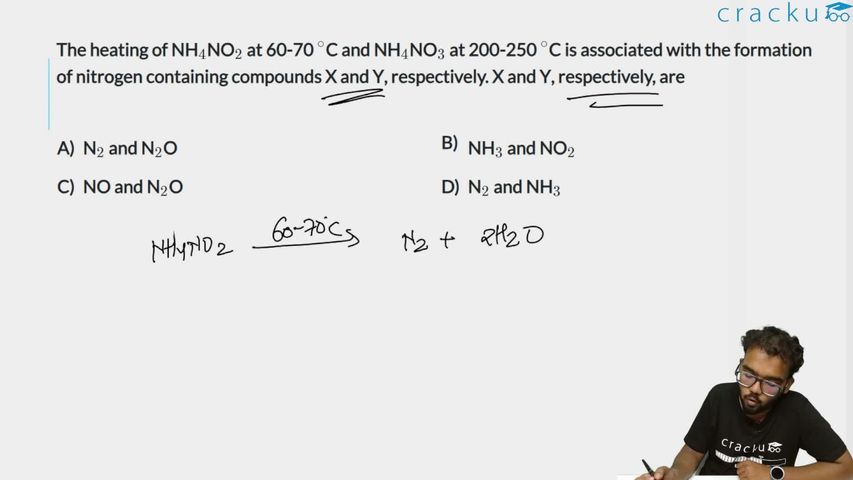
The heating of NH$$_4$$NO$$_2$$ at 60-70 $$^\circ$$C and NH$$_4$$NO$$_3$$ at 200-250 $$^\circ$$C is associated with the formation of nitrogen containing compounds X and Y, respectively. X and Y, respectively, are
When an ammonium salt contains the oxidising anion of the same oxidation state as the reducing cation (NH$$^{+}_{4}$$), gentle heating often brings about an internal redox (disproportionation) in which nitrogen changes its oxidation state and water is expelled. The exact product depends on the anion present.
Case 1 : Heating NH$$_{4}$$NO$$_{2}$$ at 60-70 $$^\circ$$C
The anion here is nitrite, $$NO_{2}^{-}$$. When warmed, ammonium nitrite undergoes complete internal oxidation-reduction forming molecular nitrogen and water:
$$\mathrm{NH_{4}NO_{2} \;\xrightarrow[\;60\;-\;70^\circ C\;]\; N_{2} + 2\,H_{2}O}$$
Thus compound X is $$\mathbf{N_{2}}$$.
Case 2 : Heating NH$$_{4}$$NO$$_{3}$$ at 200-250 $$^\circ$$C
The anion is nitrate, $$NO_{3}^{-}$$. At about 200-250 $$^\circ$$C, ammonium nitrate similarly decomposes, but because the nitrate ion is a stronger oxidising agent, the oxidation state change stops at +1, producing nitrous oxide (laughing gas) instead of $$N_{2}$$:
$$\mathrm{NH_{4}NO_{3} \;\xrightarrow[\;200\;-\;250^\circ C\;]\; N_{2}O + 2\,H_{2}O}$$
Therefore compound Y is $$\mathbf{N_{2}O}$$.
Comparing with the given options, X = $$N_{2}$$ and Y = $$N_{2}O$$ correspond to Option A.
Answer : Option A which is: $$N_{2}$$ and $$N_{2}O$$
Click on the Email ☝️ to Watch the Video Solution
Create a FREE account and get:
_1.webp)

Educational materials for JEE preparation

Ask our AI anything

AI can make mistakes. Please verify important information.
AI can make mistakes. Please verify important information.


