
Join Our JEE Preparation Group
Prep with like-minded aspirants; Get access to free daily tests and study material.
Sign in
Please select an account to continue using cracku.in
↓ →
Join Our JEE Preparation Group
Prep with like-minded aspirants; Get access to free daily tests and study material.
List-I shows various functional dependencies of energy ($$E$$) on the atomic number ($$Z$$). Energies associated with certain phenomena are given in List-II.
Choose the option that describes the correct match between the entries in List-I to those in List-II.
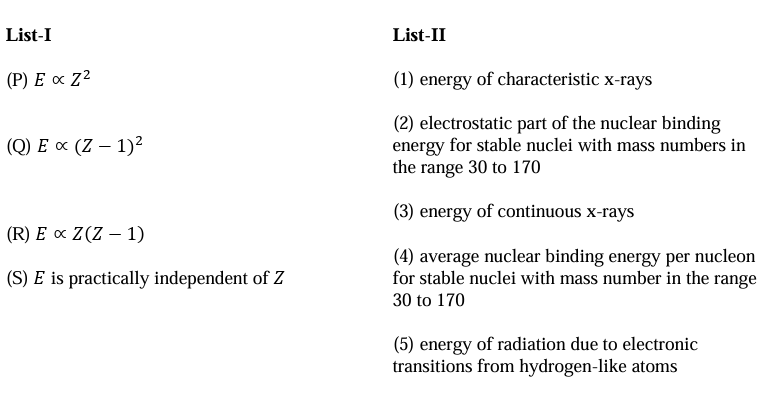
The question gives four different proportionalities of energy with atomic number $$Z$$ (List-I) and asks us to match them with the physical phenomena listed in List-II. We discuss each proportionality one by one.
Case P : $$E \propto Z^{2}$$For a hydrogen-like (one-electron) ion with nuclear charge $$+Ze$$, the Bohr model gives the energy of the $$n^{\text{th}}$$ orbit as $$E_n = -\dfrac{13.6\ \text{eV}\; Z^{2}}{n^{2}}$$ Hence the energy difference between any two levels, and therefore the photon energy emitted during an electronic transition, is proportional to $$Z^{2}$$. This exactly matches List-II entry (5) “energy of radiation due to electronic transitions from hydrogen-like atoms”.
Therefore, $$P \to 5$$.
Case Q : $$E \propto (Z-1)^{2}$$Moseley’s law for characteristic X-rays (for example, Kα, Kβ lines) is $$\nu = R\,c\,(Z-1)^{2}\left(\dfrac{1}{n_{1}^{2}}-\dfrac{1}{n_{2}^{2}}\right)$$ so the photon energy $$E = h\nu$$ also follows $$E \propto (Z-1)^{2}$$. The factor $$(Z-1)$$ accounts for the screening of one inner-shell electron.
Thus, $$Q \to 1$$ corresponding to “energy of characteristic X-rays”.
Case R : $$E \propto Z(Z-1)$$In the semi-empirical mass formula, the electrostatic (Coulomb) part of the nuclear binding energy is $$B_{C} = a_{c}\dfrac{Z (Z-1)}{A^{1/3}}$$ For medium-mass stable nuclei ($$30\le A\le170$$), $$A$$ is roughly proportional to $$Z$$, so apart from a slowly varying denominator, the numerator gives the leading dependence $$Z(Z-1)$$.
Hence, $$R \to 2$$ “electrostatic part of the nuclear binding energy for stable nuclei with mass numbers in the range 30 to 170”.
Case S : $$E$$ almost independent of $$Z$$The average binding energy per nucleon for medium-mass stable nuclei (say $$30 \le A \le 170$$) is nearly constant at about $$8\ \text{MeV}$$ and shows only a very weak dependence on $$Z$$.
This matches List-II entry (4) “average nuclear binding energy per nucleon for stable nuclei with mass number in the range 30 to 170”. Therefore, $$S \to 4$$.
Collecting all the matches:
$$P \to 5,\; Q \to 1,\; R \to 2,\; S \to 4$$
This set of correspondences is given by Option C.
Create a FREE account and get:
_1.webp)

Educational materials for JEE preparation

Ask our AI anything

AI can make mistakes. Please verify important information.
AI can make mistakes. Please verify important information.


