
Join Our JEE Preparation Group
Prep with like-minded aspirants; Get access to free daily tests and study material.
Sign in
Please select an account to continue using cracku.in
↓ →
Join Our JEE Preparation Group
Prep with like-minded aspirants; Get access to free daily tests and study material.
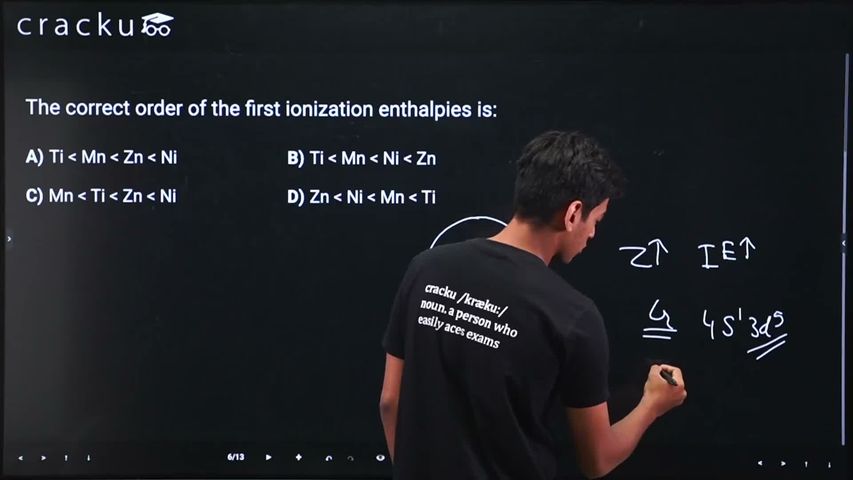
We recall that the first-ionisation enthalpy of an element is the minimum energy required to remove one electron from a gaseous atom to form a uni-positive gaseous ion:
$$\mathrm{M(g)} \;\longrightarrow\; \mathrm{M^{+}(g)} \;+\; e^{-}$$
The magnitude of this energy mainly depends on three well-known factors: (i) nuclear charge, (ii) atomic (or ionic) radius and (iii) the special stability associated with half-filled ($$d^5$$) and completely filled ($$d^{10}$$) subshells. Let us apply these ideas to the 3 d-series elements given in the options, namely titanium ($$\mathrm{Ti}$$), manganese ($$\mathrm{Mn}$$), nickel ($$\mathrm{Ni}$$) and zinc ($$\mathrm{Zn}$$).
First we write their condensed ground-state electronic configurations, explicitly separating the $$4s$$ and $$3d$$ electrons.
$$\begin{aligned} \mathrm{Ti}&:&\; [\mathrm{Ar}]\,4s^{2}\,3d^{2} \\ \mathrm{Mn}&:&\; [\mathrm{Ar}]\,4s^{2}\,3d^{5} \\ \mathrm{Ni}&:&\; [\mathrm{Ar}]\,4s^{2}\,3d^{8} \\ \mathrm{Zn}&:&\; [\mathrm{Ar}]\,4s^{2}\,3d^{10} \end{aligned}$$
Now we compare the relative stability of each configuration.
• $$\mathrm{Ti}$$ has only two $$3d$$ electrons, so it possesses no special stability.
• $$\mathrm{Mn}$$ has a half-filled $$3d^{5}$$ subshell; this is appreciably more stable than a general configuration.
• $$\mathrm{Ni}$$ has $$3d^{8}$$, which is not half-filled, but the higher effective nuclear charge (atomic number $$Z=28$$) pulls its electrons closer than in $$\mathrm{Mn}$$, making removal harder.
• $$\mathrm{Zn}$$ has a completely filled $$3d^{10}$$ subshell together with $$4s^{2}$$; removal of the first electron disturbs a very stable configuration, so its ionisation enthalpy is the highest of the four.
The net effect of increasing nuclear charge from $$\mathrm{Ti} \;(Z=22)$$ to $$\mathrm{Zn} \;(Z=30)$$ is a general rise in ionisation enthalpy, but the half-filled and completely filled cases cause noticeable jumps. When the experimental values (in kJ mol-1) are consulted, we obtain
$$ \mathrm{Ti}:658 \quad\qquad\quad \mathrm{Mn}:717 \quad\qquad\quad \mathrm{Ni}:737 \quad\qquad\quad \mathrm{Zn}:906 $$
Writing them in ascending order we clearly have
$$\mathrm{Ti}\; \lt \; \mathrm{Mn}\; \lt \; \mathrm{Ni}\; \lt \; \mathrm{Zn}$$
This inequality corresponds exactly to Option B.
Hence, the correct answer is Option B.
Was this solution helpful?
Click on the Email ☝️ to Watch the Video Solution
Create a FREE account and get:
Educational materials for JEE preparation

Ask our AI anything

AI can make mistakes. Please verify important information.
AI can make mistakes. Please verify important information.

_1.webp)
