
Join Our JEE Preparation Group
Prep with like-minded aspirants; Get access to free daily tests and study material.
Sign in
Please select an account to continue using cracku.in
↓ →
Join Our JEE Preparation Group
Prep with like-minded aspirants; Get access to free daily tests and study material.
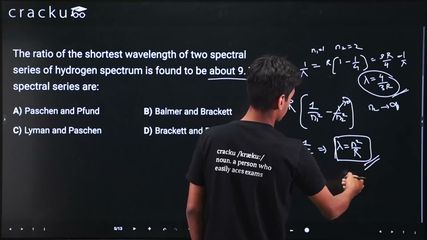
The ratio of the shortest wavelength of two spectral series of hydrogen spectrum is found to be about 9. The spectral series are:
We have to compare the shortest (limit) wavelengths of two spectral series in hydrogen. For any transition in hydrogen, the Rydberg formula gives
$$\frac{1}{\lambda}=R\left(\frac{1}{n_1^{\,2}}-\frac{1}{n_2^{\,2}}\right),$$
where $$R$$ is the Rydberg constant, $$n_1$$ is the lower (fixed) orbit for the series, and $$n_2$$ is the upper orbit with $$n_2\gt n_1$$.
The “shortest wavelength” (i.e. the series limit) is obtained by letting the electron fall from $$n_2\to\infty$$. In that limit the term $$1/n_2^{\,2}$$ vanishes, so
$$\frac{1}{\lambda_{\min}} = R\left(\frac{1}{n_1^{\,2}}-0\right)=\frac{R}{n_1^{\,2}}.$$
Taking the reciprocal we obtain an explicit expression for the shortest wavelength in a series:
$$\lambda_{\min}= \frac{n_1^{\,2}}{R}.$$
Now we are told that the ratio of the shortest wavelengths of two different series is about $$9$$. Let the two lower quantum numbers be $$n_{1a}$$ and $$n_{1b}$$. Then
$$\frac{\lambda_{\min,a}}{\lambda_{\min,b}} =\frac{\dfrac{n_{1a}^{\,2}}{R}}{\dfrac{n_{1b}^{\,2}}{R}} =\frac{n_{1a}^{\,2}}{n_{1b}^{\,2}} =9.$$
Cancelling the common factor $$R$$ and taking the square root on both sides, we find
$$\frac{n_{1a}}{n_{1b}} = \sqrt{9}=3.$$
Hence the two series must have lower quantum numbers whose ratio is exactly $$3:1$$.
The known values of $$n_1$$ for the named hydrogen series are:
$$\text{Lyman: }n_1=1,\quad \text{Balmer: }n_1=2,\quad \text{Paschen: }n_1=3,\quad \text{Brackett: }n_1=4,\quad \text{Pfund: }n_1=5.$$
To satisfy $$n_{1a}/n_{1b}=3$$, the only possible pair from this list is $$n_1=3$$ (Paschen) and $$n_1=1$$ (Lyman). Indeed,
$$\frac{\lambda_{\min,\text{Paschen}}}{\lambda_{\min,\text{Lyman}}} =\frac{3^{2}/R}{1^{2}/R}=9,$$
exactly as required.
Therefore, the two spectral series are Lyman and Paschen.
Hence, the correct answer is Option C.
Was this solution helpful?
Click on the Email ☝️ to Watch the Video Solution
Create a FREE account and get:
_1.webp)

Educational materials for JEE preparation

Ask our AI anything

AI can make mistakes. Please verify important information.
AI can make mistakes. Please verify important information.
