
Join Our JEE Preparation Group
Prep with like-minded aspirants; Get access to free daily tests and study material.
Sign in
Please select an account to continue using cracku.in
↓ →
Join Our JEE Preparation Group
Prep with like-minded aspirants; Get access to free daily tests and study material.
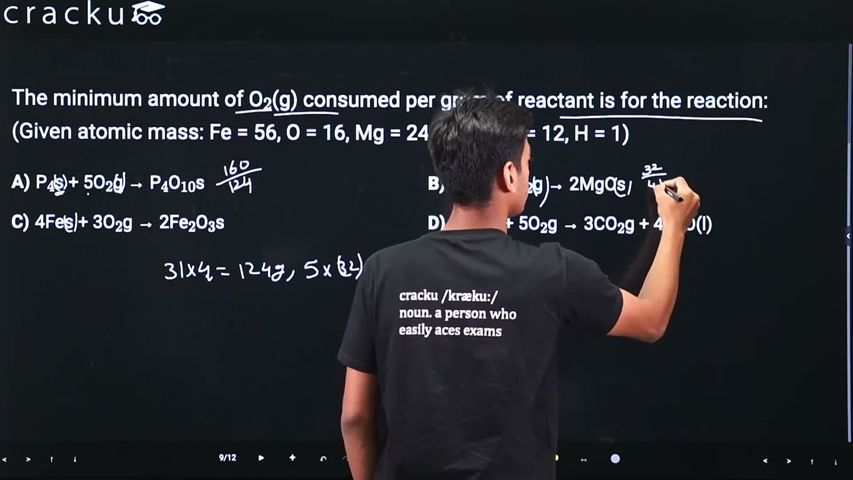
The minimum amount of O$$_2$$(g) consumed per gram of reactant is for the reaction:
(Given atomic mass: Fe = 56, O = 16, Mg = 24, P = 31, C = 12, H = 1)
We have to find, for each given reaction, how many grams of molecular oxygen are required by stoichiometry when just one gram of the other reactant(s) is taken. The reaction that asks for the smallest such number will be the answer.
For every reaction we shall first write down the balanced equation, then calculate:
$$\text{Grams of } {\rm O}_2$$ consumed per gram of the other reactant $$\;=\; \frac{ \text{Mass of } {\rm O}_2$$ demanded by the equation $$} {$$ Mass of the non-oxygen reactant(s) consumed with it $$}$$
Atomic (or molecular) masses to be used are $${\rm Fe}=56,\;{\rm O}=16,\;{\rm Mg}=24,\;{\rm P}=31,\; {\rm C}=12,\;{\rm H}=1,\; {\rm O}_2=32.$$
Reaction A $$\mathrm{P_4}+5\mathrm{O_2}\rightarrow\mathrm{P_4O_{10}}$$
One mole of $$\mathrm{P_4}$$ weighs $$4\times31=124\ \text{g}$$.
Five moles of $$\mathrm{O_2}$$ weigh $$5\times32=160\ \text{g}$$.
Hence the ratio is $$ \frac{160}{124}=1.29\ \text{g }{\rm O}_2\ /\ \text{g }{\rm P_4}. $$
Reaction B $$2\mathrm{Mg}+\mathrm{O_2}\rightarrow2\mathrm{MgO}$$
Two moles of $$\mathrm{Mg}$$ weigh $$2\times24=48\ \text{g}$$.
One mole of $$\mathrm{O_2}$$ weighs $$32\ \text{g}$$.
So $$ \frac{32}{48}=0.667\ \text{g }{\rm O}_2\ /\ \text{g Mg}. $$
Reaction C $$4\mathrm{Fe}+3\mathrm{O_2}\rightarrow2\mathrm{Fe_2O_3}$$
Four moles of $$\mathrm{Fe}$$ weigh $$4\times56=224\ \text{g}$$.
Three moles of $$\mathrm{O_2}$$ weigh $$3\times32=96\ \text{g}$$.
Hence $$ \frac{96}{224}=0.429\ \text{g }{\rm O}_2\ /\ \text{g Fe}. $$
Reaction D $$\mathrm{C_3H_8}+5\mathrm{O_2}\rightarrow3\mathrm{CO_2}+4\mathrm{H_2O}$$
One mole of $$\mathrm{C_3H_8}$$ weighs $$3\times12+8\times1=44\ \text{g}$$.
Five moles of $$\mathrm{O_2}$$ weigh $$5\times32=160\ \text{g}$$.
Thus $$ \frac{160}{44}=3.636\ \text{g }{\rm O}_2\ /\ \text{g }{\rm C_3H_8}. $$
Comparing all four ratios:
$$\begin{aligned} {\rm A}:&\;1.29,\qquad {\rm B}:&\;0.667,\qquad {\rm C}:&\;0.429,\qquad {\rm D}:&\;3.636. \end{aligned}$$
The smallest value, $$0.429\ \text{g }{\rm O}_2\ /\ \text{g reactant},$$ belongs to Reaction C.
Hence, the correct answer is Option C.
Was this solution helpful?
Click on the Email ☝️ to Watch the Video Solution
Create a FREE account and get:
_1.webp)

Educational materials for JEE preparation

Ask our AI anything

AI can make mistakes. Please verify important information.
AI can make mistakes. Please verify important information.
