
Join Our JEE Preparation Group
Prep with like-minded aspirants; Get access to free daily tests and study material.
Sign in
Please select an account to continue using cracku.in
↓ →
Join Our JEE Preparation Group
Prep with like-minded aspirants; Get access to free daily tests and study material.
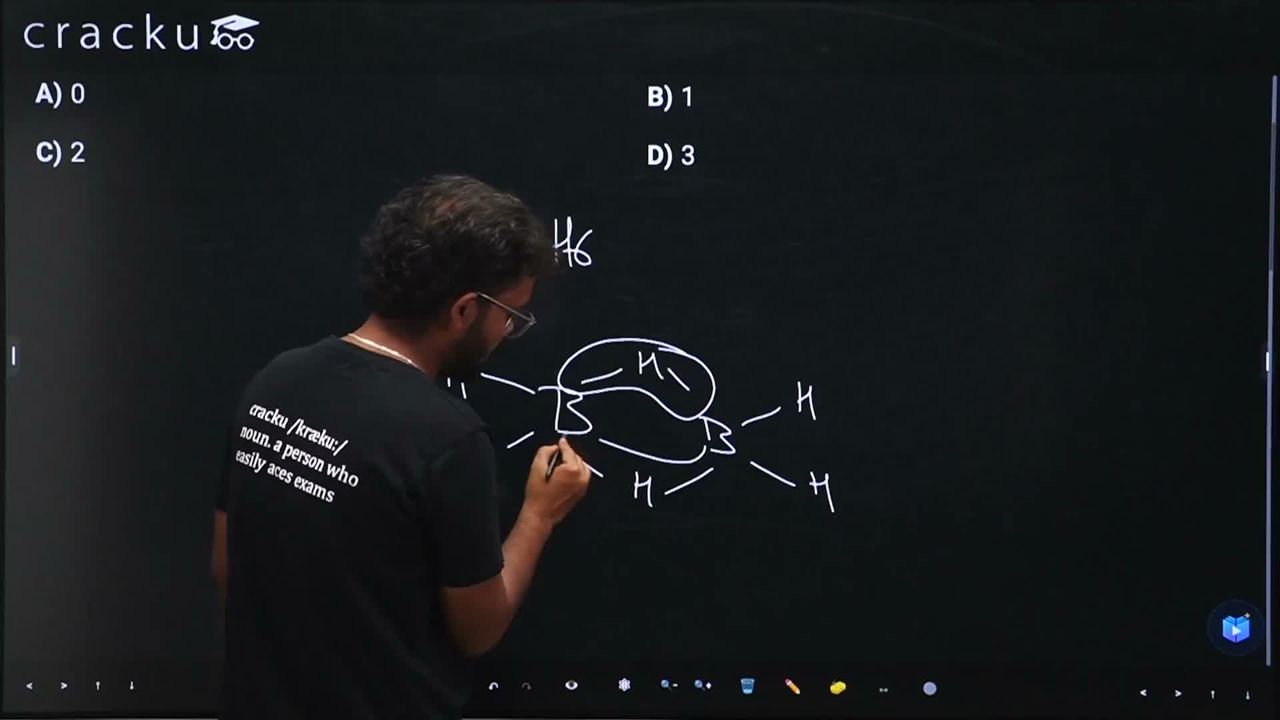
Number of electron deficient molecules among the following $$PH_3, B_2H_6, CCl_4, NH_3, LiH$$ and $$BCl_3$$ is
An electron deficient molecule is one in which the central atom has fewer than 8 electrons in its valence shell (incomplete octet).
Let us check each molecule:
$$PH_3$$: Phosphorus has 5 valence electrons, forms 3 bonds with H and has 1 lone pair = 8 electrons around P. Not electron deficient.
$$B_2H_6$$: Boron has only 3 valence electrons. In $$B_2H_6$$, each boron is involved in 4 bonds but through 3-centre 2-electron bonds. Each B effectively has only 6 electrons in its valence shell. Electron deficient.
$$CCl_4$$: Carbon has 4 valence electrons, forms 4 bonds = 8 electrons around C. Not electron deficient.
$$NH_3$$: Nitrogen has 5 valence electrons, forms 3 bonds and has 1 lone pair = 8 electrons around N. Not electron deficient.
$$LiH$$: This is an ionic compound ($$Li^+$$ and $$H^-$$). It is not considered electron deficient in this context as $$H^-$$ has a complete 1s shell and $$Li^+$$ has a complete 1s shell.
$$BCl_3$$: Boron has 3 valence electrons, forms 3 bonds = only 6 electrons around B. Electron deficient.
The electron deficient molecules are $$B_2H_6$$ and $$BCl_3$$, giving a count of 2.
The correct answer is Option C.
Was this solution helpful?
Click on the Email ☝️ to Watch the Video Solution
Create a FREE account and get:
_1.webp)

Educational materials for JEE preparation

Ask our AI anything

AI can make mistakes. Please verify important information.
AI can make mistakes. Please verify important information.
